The Sustainability Gap in Lean Implementation
Many organisations which start to implement Lean gain hugely in the initial stages and slowly the efforts die off and so the Lean implementations fail to last. Let us look at the reasons and what can be done to avoid such failures.
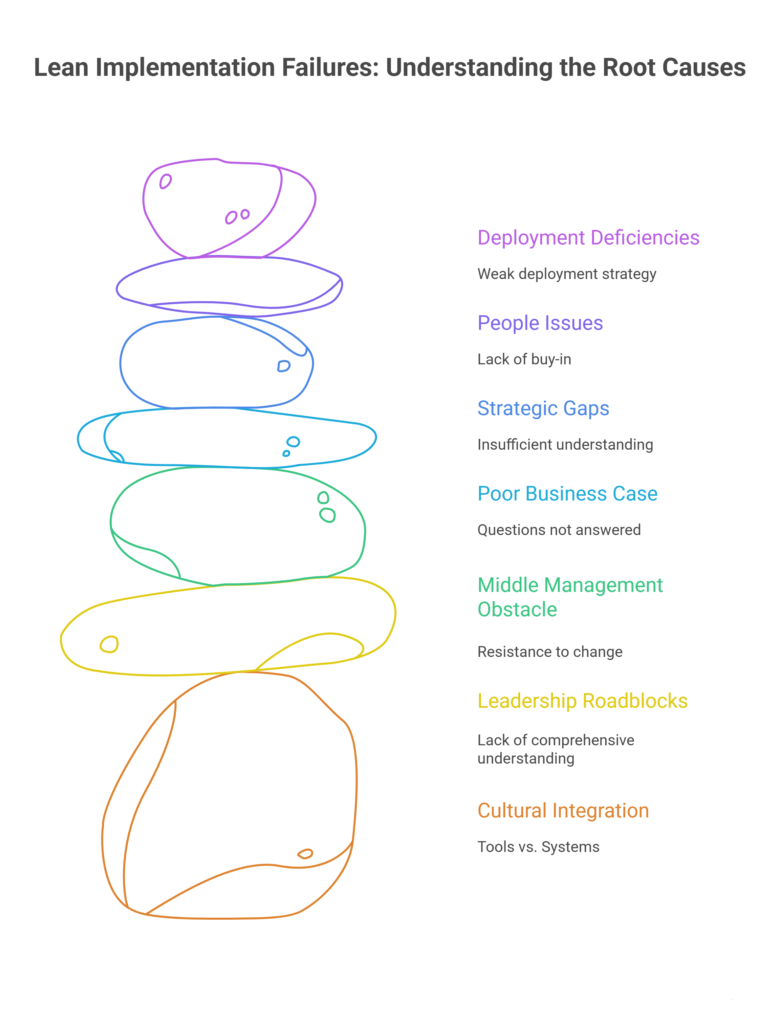
Lean works. Lean is right. Lean is good. Lean consistently proves its worth through continuous, stepwise gains for companies brave enough to take on the challenge of looking within themselves to correct deep founded issues with their status quo and historical patterns of behaviours. So, why doesn’t Lean help every company that implements it? The truth is, Lean doesn’t work for some companies because THEY (i.e. the companies it doesn’t work for) don’t allow it to work for them. And that is why Lean fails.
The Challenge of Cultural Integration
Lean implementations fail to achieve all the successes promised because something more is needed. It has been over 20 years since the Lean evolution took roots in the western world. Many companies have implemented some of the principles of Lean like “5S” or “SMED – Single Minute Exchange of Dies” or “Just in Time Inventory” or “Pull” systems. But according to Jeffery K. Liker, in his 2004 book The Toyota Way: 14 Management Principles from the World’s Greatest Manufacturer, almost no American business has realized the potential of following the Lean principles of the Toyota Way. Many have attempted to replicate Toyota’s success but none have matched the dramatic improvements achieved by Toyota. Why is it that with so much good writing and so many Lean implementations that so few American companies have fully realized the benefits of the Lean revolution?
Tools vs. Systems
“The U.S. has been exposed to TPS (Toyota Production System) for at least two decades. The basic concepts and tool are not new…The problem I believe, is that U.S. companies have embraced Lean tools but do not understand what makes them work together in a system. Typically management adopts a few of these technical tools and even struggles to go beyond the amateurish application of them to create a technical system. But they do not understand the power behind true TPS, (Toyota Production System): The continuous improvement culture needed to sustain the principles of the Toyota Way… Their performance will continue to lag behind those that adopt a true culture of continuous improvement.” (Liker 2004)
Leadership and Strategic Roadblocks
The most common roadblock to the successful implementation of Lean is the failure on the part of management – and particularly senior level leaders – to understand Lean as a comprehensive approach to managing a business. Too often, company leaders lack the total commitment to, and understanding of Lean, that is essential to its adoption, and are unwilling to be involved in its day-to-day implementation and application. Lean is not simply a set of concepts, techniques and methods, which can be implemented by command and control. Rather, it is a fully integrated management and manufacturing philosophy and approach which must be practiced throughout the organization from top to bottom and consistently applied and improved day in and day out.
Another common reason Lean implementations fail is that managers try to implement individual elements instead of the entire Lean approach. Since the elements of Lean are integrated and interdependent, any attempt to implement Lean only partially is bound to produce very unsatisfactory results.
The Middle Management Obstacle
An annual survey from Lean.org in July 2007, stated “Middle Managers Are Biggest Obstacle to Lean Enterprise”. Nearly 40 percent of those polled cite middle management resistance, according to Lean Enterprise Institute.
Survey Findings on Resistance
“Middle management resistance was cited by 36.1 percent of respondents in LEI’s annual survey about lean business system implementation in the U.S. The top three obstacles to implementation were middle management resistance (36.1 percent), Lack of implementation know-how (31 percent), and employee resistance (27.7 percent). The survey was completed by nearly 2,500 businesspeople and conducted by the Lean Enterprise Institute, a non-profit management research centre”.
“Last year, backsliding to the old ways of working was the primary obstacle to introducing lean management principles, followed by lack of implementation know-how and middle management resistance. Backsliding dropped to sixth place in this year’s survey”.
Conflicting Metrics and Traditional Thinking
“Applying lean management principles exposes problems in traditional business systems, which often is threatening to middle managers in the problem areas,” said Chet Marchwinski, LEI communication director. “To get middle managers on board with the lean transformation, organizations must transform the metrics and behaviours for judging their performances.”
Middle managers have their hands tied. Too often, they are bound to their traditional metrics and methods of thinking. This leads to production managers and supervisors pushing for their employees and work centres to be producing at 100% capacity just for the sake of running production and keep uptime on par with traditional company goals. This just creates over production, mismanaged inventories, misinformed operators, and in the end, a complete resistance to Lean Thinking. In the end, for too many middle managers, production trumps Lean and Six Sigma because it’s all “ship, ship, ship….this product is a rush….ship, ship, ship”. It’s rather ironic that all of these managers’ practices are the very nature and source of their need to have a always rushing mentality.
Pillars of Successful Implementation
The most important part of Lean implementation is preparation;
- Firstly an objective assessment and development of the business and technical cases for Lean implementation
- Secondly Structure and leadership that can get things done, appropriate training, resolution of people issues, and well-designed deployment methods.
One of the most misunderstood issues regarding Lean is its implementation. There are three categories of causes responsible for the failure of Lean implementations:
- Lack of leadership from the top
- People issues
- Poor Deployment methods
Deep Dive into Top Management Leadership
Almost all Lean experts agree that the main reasons for implementation failures involve lack of senior management commitment and ownership. These people are ultimately responsible for everything that happens, or doesn’t, in an organisation.
However, simply blaming the top people for these types of failures is not very useful. The following are the actual reasons for failure and their causes.
1. Poor Development of the Business Case
The key business case questions listed below are either not asked, or not answered, satisfactorily. Unless there is a strong business case for Operational Excellence, it is very hard for top management to develop the passion and determination necessary to implement it, and the initiative likely will flounder.
- Why implement it?
- How much does it cost to implement?
- What are the benefits?
- What are the risks to realising those benefits?
- What are the impediments to implementation?
- What are the alternatives?
- What happens if we don’t invest?
- What people resources do we need to commit?
- Over what period of time?
2. Strategic and Organizational Gaps
- Insufficient Understanding of Operational Excellence and Its Elements
- Insufficient Top Management Focus and Involvement
- Lack of Communication and the way it is communicated
- Poor Organizational and Leadership Development
- Lack of Proper Performance Management Systems
People and Capability Issues
While Operational Excellence, like almost everything else related to business, relies on the brains, commitment, and energies of people, the causes for the most common failures related to individuals can be summed up in two main categories.
- Lack of Middle-Management Buy-in
- Management or Employee Capabilities Are Lacking
Deficiencies in Deployment Methods
Operational Excellence can also fail because of the approach and deployment methods.
- Weak Operational Excellence Deployment Strategy
- Insufficient or Inappropriate Training
- Failure to Learn Proper CI Methodology
- Reliance on a Single In-house Champion or Expert
Conclusion
Operational Excellence implementation is not simple or easy. However, results show that, when done properly, Operational Excellence lives up to its promises. Operational Excellence and its elements work. All of the failure modes presented here can be avoided with proper planning.