-
The Essence of Toyota Way (PDF) as explained by Dr. Jeffrey Liker
The Toyota Way to Lean Excellence
This presentation outlines the Toyota Way philosophy, detailing its core principles and historical development. It explains Lean manufacturing as a systematic approach to eliminate waste, improve flow, and foster continuous improvement, highlighting its application beyond traditional manufacturing to sectors like healthcare. The four Ps of the Toyota Way – Philosophy, Process, People and Partners, and Problem Solving – are introduced as foundational elements for sustained excellence. Through case studies, such as the Donnelly Mirrors plant, the material illustrates how these principles lead to significant improvements in quality, cost, and lead time. Finally, the presentation stresses the importance of people development and a long-term commitment from leadership to embed a culture of continuous improvement, preventing entropy and ensuring the enduring success of lean implementation.$ 99$ 109 -
OpEx-SCM Fundamentals – Aggregate Planning
Aggregate Planning for Supply Chains
The source, titled “OpEx – SCM Funda3 Planning.pdf” by Vishnu Rayapeddi, provides a comprehensive overview of aggregate planning within supply chain management. It outlines the requirements, tasks, responsibilities, and relationships involved in this crucial planning process, which typically spans 3 to 18 months. The document details various aggregate planning goals such as meeting demand and minimising costs, and explores different pure strategies including adjusting capacity options (e.g., inventory levels, workforce size, subcontracting) and demand options (e.g., influencing demand, backordering). It further presents production strategies like chase, level, subcontracting, and hybrid approaches, along with their respective advantages and disadvantages, before discussing aggregate planning methods such as graphical techniques and mathematical models. Finally, the source touches upon controlling labour costs in service firms and the concept of yield management$ 20$ 24 -
OpEx – VSM, Value Stream Mapping
Value Stream Mapping
The provided source, “OpEx – VSM.pdf” by Vishnu Rayapeddi, serves as a comprehensive guide to Value Stream Mapping (VSM), a critical component of Operational Excellence. It outlines an eight-step roadmap for implementing VSM, beginning with a commitment to lean principles and culminating in continuous improvement. The document explains how VSM helps visualise entire value streams, identify and eliminate non-value-adding activities (waste), and ultimately improve efficiency and customer satisfaction within manufacturing, administrative, and service sectors. Key concepts such as Takt Time, flow, pull systems, and levelling production are explored, providing practical methods for optimising processes and achieving significant cost reductions and$ 59$ 69OpEx – VSM, Value Stream Mapping
$ 59$ 69 -
OpEx-5SVC-5S and Visual Controls
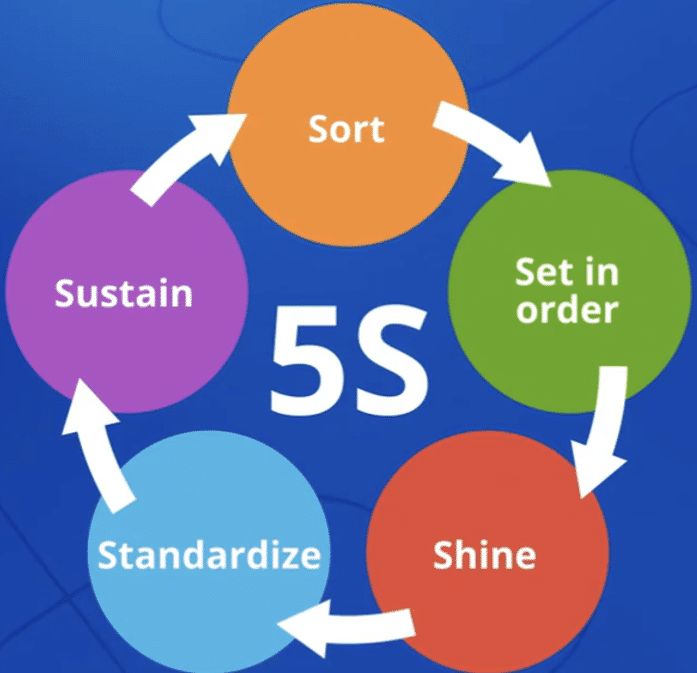
The source, titled “5S & Visual Controls for High Performance Workplace” by Vishnu Rayapeddi, outlines a comprehensive workshop focused on implementing the 5S methodology within an operational setting. This approach, originating from lean manufacturing principles, aims to create a safe, clean, and organised workplace to improve efficiency and quality. The document details each of the five “S” steps: Sort, Set-in-Order, Shine, Standardise, and Sustain, providing practical guidance, self-assessment tools, and examples for implementation. Ultimately, the objective is to achieve “World-Class Manufacturing” through disciplined workplace organisation and the effective use of visual controls and displays to communicate information and manage processes.
$ 54$ 64OpEx-5SVC-5S and Visual Controls
$ 54$ 64 -
OpEx – SCM Fundamentals – MRP-Materials Requirement Planning
The source “OpEx-SCM Funda4 MRP.pdf” provides an overview of Materials Requirement Planning (MRP), a crucial component of supply chain management. It begins by distinguishing dependent versus independent demand and details the planning process that leads to Material Requirements Planning. The document explains Bills-of-Material (BOM), including different types like modular and phantom bills, and outlines the structure and benefits of an MRP system. Furthermore, it explores extensions of MRP, such as Closed Loop MRP, Capacity Planning, Manufacturing Resource Planning (MRP II), Enterprise Resource Planning (ERP), and Distribution Resource Planning (DRP), illustrating the evolution of these systems and their applications in both manufacturing and service sectors.
$ 24$ 29 -
OpEx – SCM Fundamentals – Demand Forecasting
This source, titled “OpEx- SCM Funda2 Forecasting.pdf” by Vishnu Rayapeddi, provides an extensive overview of demand forecasting within supply chain management. It begins by defining forecasting as educated guessing and a crucial process for business decisions across various time horizons, from short-range (under one year) to long-range (over three years). The document details different types of forecasts, including economic, technological, and demand, and outlines seven key steps in the forecasting process, from determining its use to validating results. Furthermore, the text distinguishes between qualitative forecasting methods (like the Delphi method and sales force composite) and quantitative methods (such as moving averages, exponential smoothing, and linear regression), explaining their applications and calculations, including metrics like Mean Absolute Deviation (MAD) and tracking signals for monitoring forecast accuracy.
$ 34$ 39 -
OpEx – SSGB, Six Sigma Green Belt Training PPT
This text provides a comprehensive overview of Operational Excellence and Six Sigma methodologies, detailing their importance in enhancing business profitability, customer satisfaction, and market competitiveness. It introduces key quality management gurus like Deming, Juran, Crosby, Ishikawa, and Taguchi, outlining their foundational philosophies and contributions to quality improvement. The document then thoroughly explores the Six Sigma project lifecycle, from defining and measuring processes to analysing root causes, implementing solutions, and establishing robust control plans. Crucially, it integrates concepts of stakeholder management, financial analysis, and various data collection and analysis tools essential for successful Six Sigma implementatio
$ 249$ 269 -
Martial Arts Business Plan Template
Unlock the potential of your martial arts school with Oak Business Consultant’s Martial Arts Business Plan template. Tailored for the dynamic martial arts industry, this template guides you through strategic planning, effective marketing, and financial mastery. Propel your school toward success by targeting the right audience and achieving operational excellence.
$ 250$ 280Martial Arts Business Plan Template
$ 250$ 280 -
Singing School Business Plan Template
The Singing School Business Plan is your key to unlocking the world of successful music education. Immerse yourself in a plan that combines passion with strategy, offering a unique blend of experienced instructors, a detailed curriculum, and a commitment to high-quality music education. Join us in creating harmonies that resonate for generations. Enroll in the plan, and let your musical journey begin!
$ 250$ 280Singing School Business Plan Template
$ 250$ 280 -
Spa Business Plan Template
Starting a spa business is an exciting opportunity in the growing wellness industry. Whether it’s a day spa, beauty salon, or wellness center, a solid business plan is crucial for success. This guide provides a detailed spa business plan template to help you create a professional and actionable strategy, covering essential sections to attract customers and investors alike.
$ 250$ 280Spa Business Plan Template
$ 250$ 280