
E-Commerce Financial Projection Model
$ 60
The model is designed to provide e-commerce founders, operators, and finance teams with a comprehensive financial projection framework spanning five years. It enables you to forecast revenue across multiple sales channels, evaluate profitability under different growth scenarios, and present investor-ready financials with institutional-grade structure.
The template is organized into six integrated worksheets: an Instructions tab, an Assumptions and Inputs tab, a Revenue Model tab, a Profit and Loss Statement, a Cash Flow Statement, and a Dashboard.
Whether you are preparing projections for a fundraise, building an annual operating plan, or stress-testing your business under different market conditions, this model gives you the tools to make informed decisions with confidence.
What is the E-Commerce Financial Projection Model for?
The model is designed to provide e-commerce founders, operators, and finance teams with a comprehensive financial projection framework spanning five years. It enables you to forecast revenue across multiple sales channels, evaluate profitability under different growth scenarios, and present investor-ready financials with institutional-grade structure.
The template is organized into six integrated worksheets: an Instructions tab, an Assumptions and Inputs tab, a Revenue Model tab, a Profit and Loss Statement, a Cash Flow Statement, and a Dashboard.
Whether you are preparing projections for a fundraise, building an annual operating plan, or stress-testing your business under different market conditions, this model gives you the tools to make informed decisions with confidence.
What is included in the template?
The model contains six worksheets that flow logically from assumptions through to a visual summary. All sheets are fully integrated, so changes in the Assumptions tab cascade automatically through the entire model.
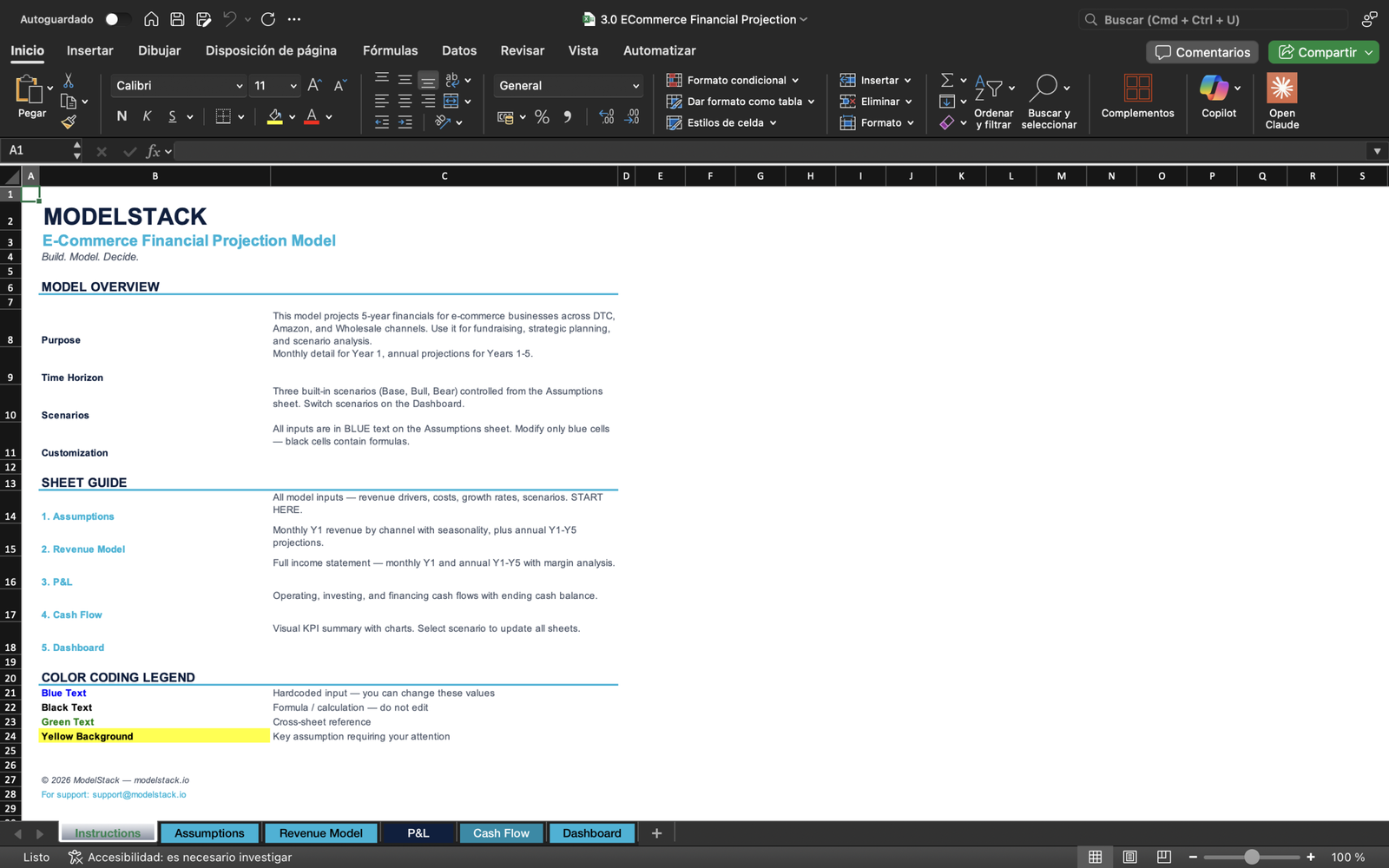
1. Instructions
A complete user guide with the color-coding legend, a description of each worksheet, and key definitions. This sheet walks you through the model structure so you can start customizing immediately without guesswork.
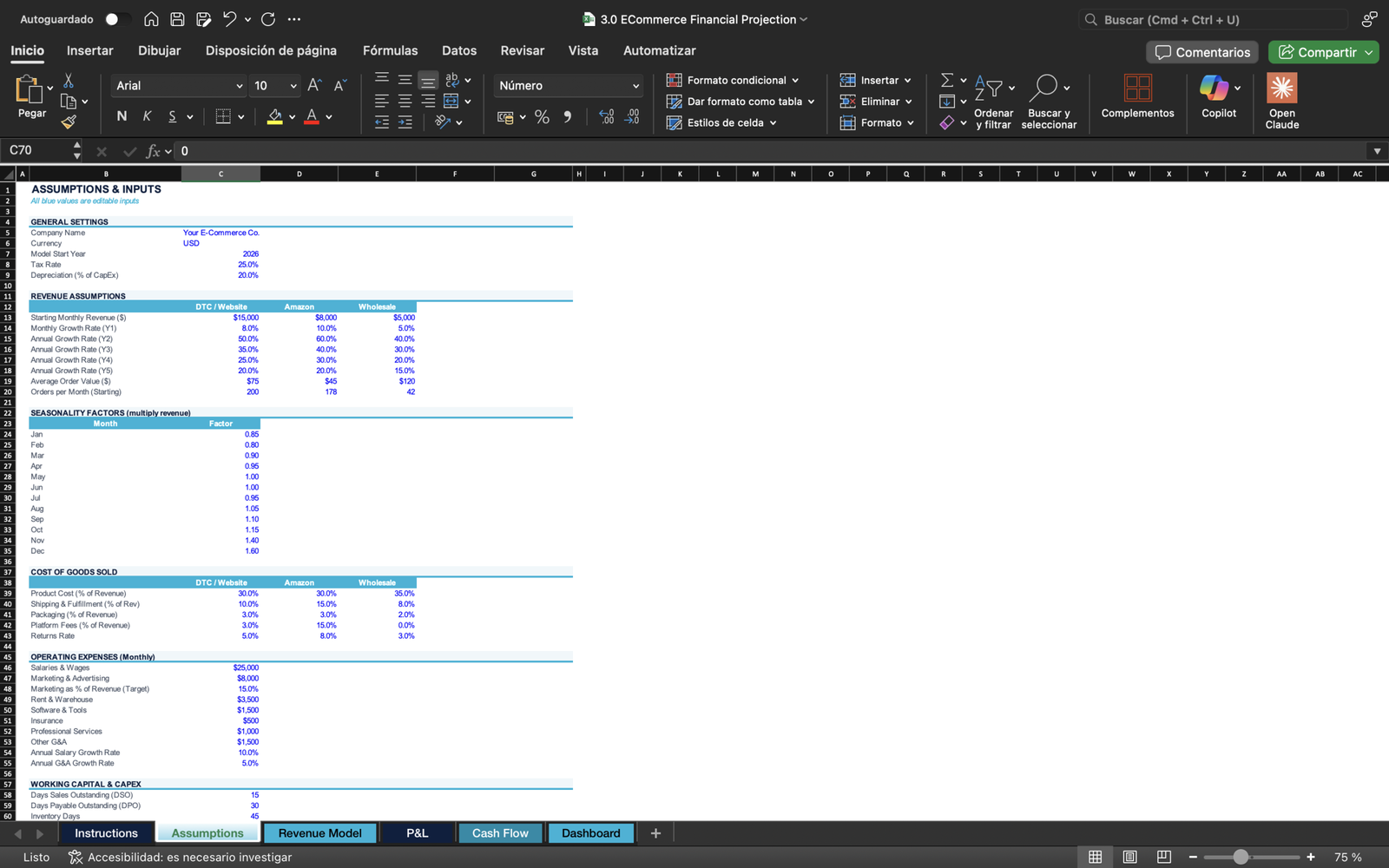
2. Assumptions & Inputs
All editable inputs are consolidated on this sheet. Key assumptions include:
• Revenue by channel: Annual base revenue for Direct-to-Consumer (DTC), Amazon, and Wholesale channels, with year-over-year growth rates for each.
• Monthly seasonality: A 12-month seasonality curve that distributes annual revenue across months, capturing peaks like Black Friday, holiday season, and summer slowdowns.
• Cost of Goods Sold (COGS): COGS percentages by channel, reflecting the different cost structures of DTC, Amazon (including platform fees), and Wholesale.
• Operating expenses: Marketing, payroll, rent, software, shipping and logistics, and other general and administrative expenses with annual growth assumptions.
• Working capital: Days Sales Outstanding, Days Payable Outstanding, and inventory days to model cash conversion timing.
• Capital expenditures: CapEx inputs and depreciation assumptions for asset-related planning.
• Scenario multipliers: Revenue and cost adjustment factors for Base, Bull, and Bear scenarios, controlled by a single toggle that drives the entire model.
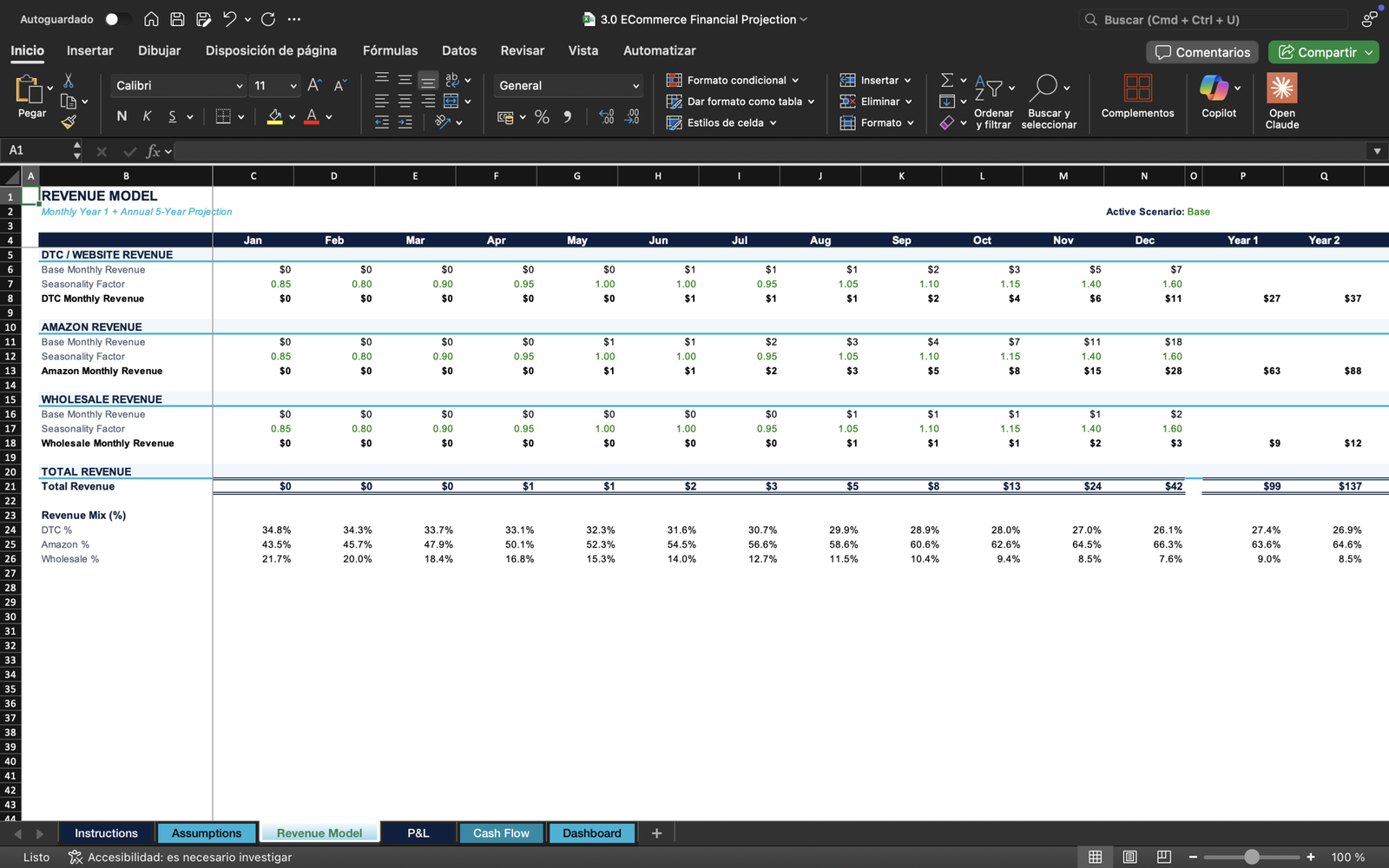
3. Revenue Model
This tab projects revenue at two levels of granularity. For Year 1, you will see monthly projections by channel with seasonality applied, giving you a detailed view of cash flow timing. For Years 1 through 5, annual projections by channel show the growth trajectory. The revenue mix (percentage contribution of DTC, Amazon, and Wholesale) is calculated automatically so you can monitor channel diversification over time.
4. Profit & Loss Statement
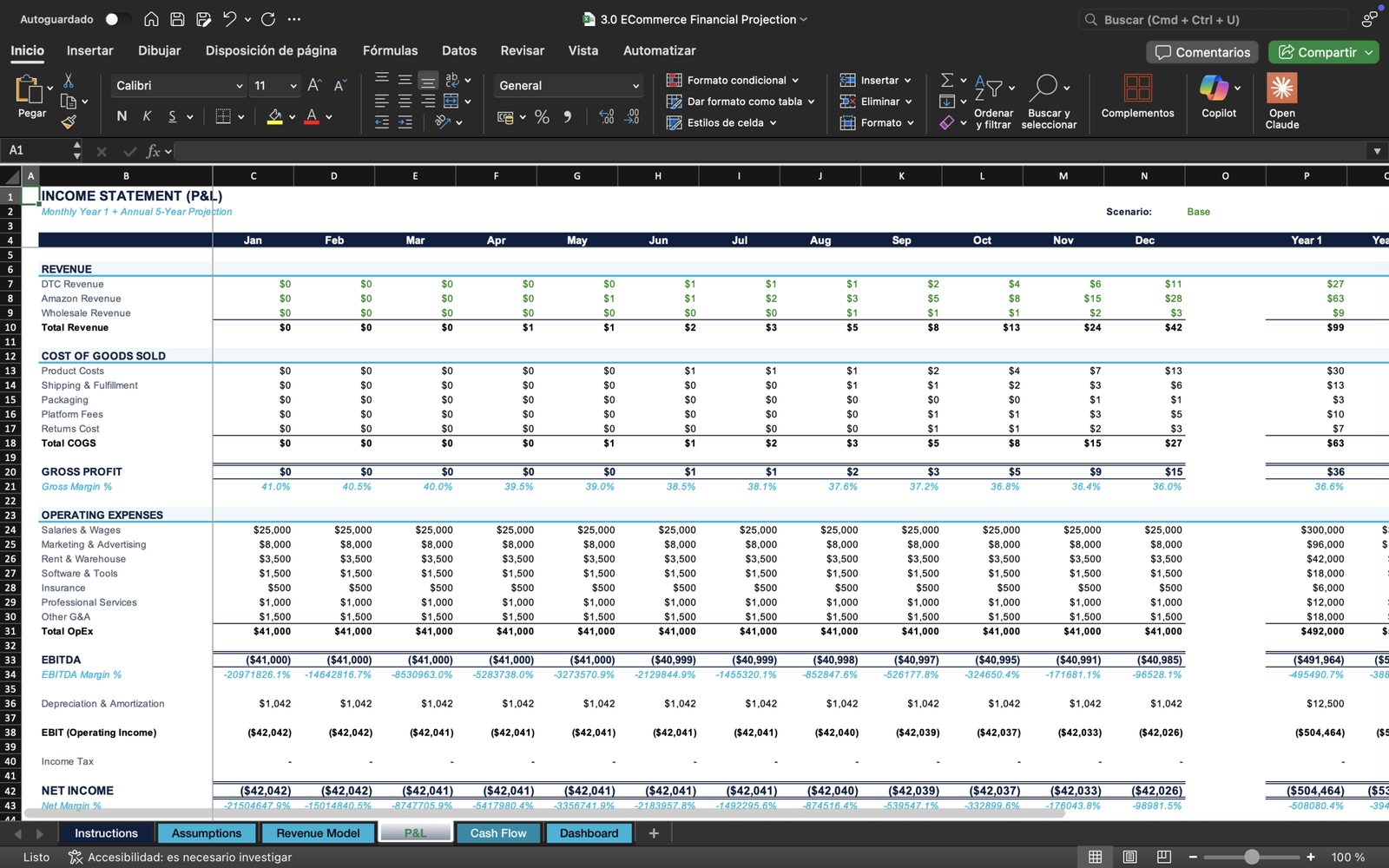
A full income statement flowing from Revenue through Cost of Goods Sold to Gross Profit, then through Operating Expenses to EBITDA, and finally through Depreciation and Amortization, EBIT, and Taxes to arrive at Net Income. Margins are calculated at every level (gross margin, EBITDA margin, EBIT margin, net margin) for each year of the projection. This gives investors and operators a clear picture of how profitability evolves as the business scales.
5. Cash Flow Statement
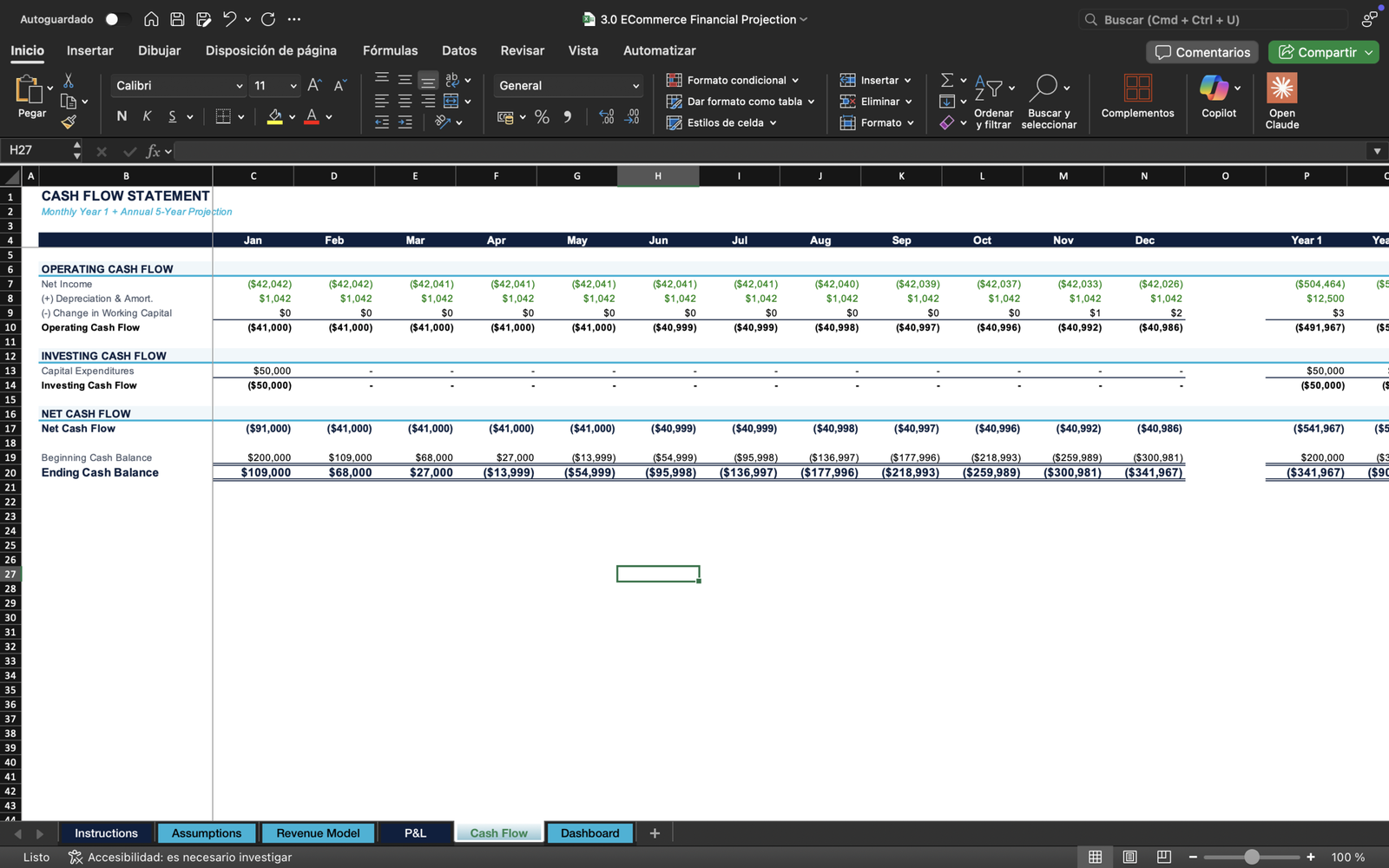
The cash flow statement is divided into Operating, Investing, and Financing activities. Operating cash flow starts with Net Income and adjusts for non-cash items and working capital changes (accounts receivable, inventory, and accounts payable movements). Investing cash flow captures capital expenditures. The net cash flow and cumulative cash balance are tracked across the projection period, allowing you to identify funding needs and cash runway at a glance.
6. Dashboard
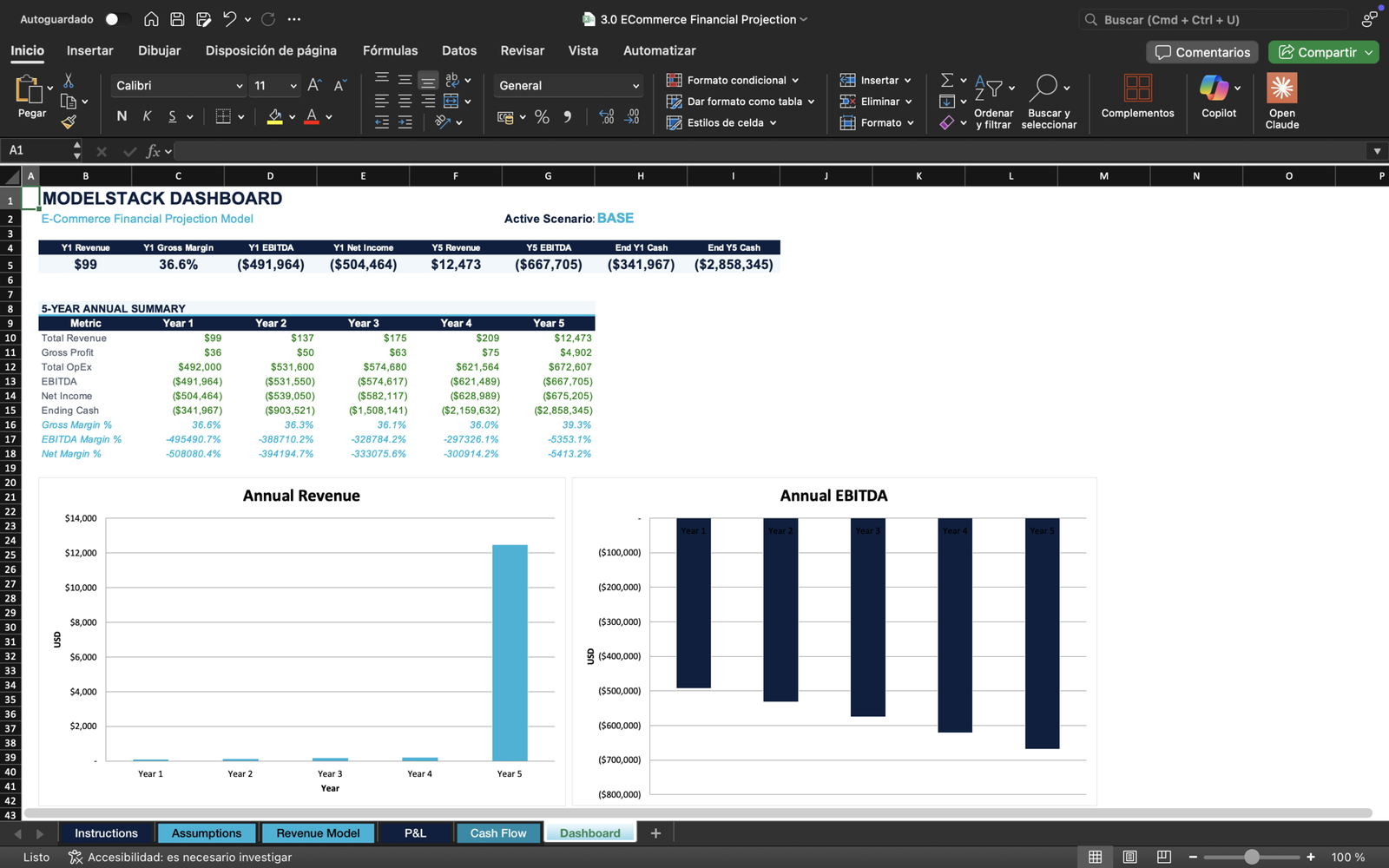
A visual summary that pulls the most important outputs from the model into a single view. The Dashboard includes:
• 8 headline KPIs: Year 5 Revenue, Year 5 Gross Margin, Year 5 EBITDA, Year 5 Net Income, 5-Year Revenue CAGR, Year 5 EBITDA Margin, Year 5 Cash Balance, and Year 1 Revenue.
• 5-Year summary table: Revenue, Gross Profit, EBITDA, Net Income, and Cash Balance with corresponding margins for each year.
• Charts: Annual Revenue by Channel and EBITDA trend charts that update dynamically based on the active scenario.
General Inquiries
There are no inquiries yet.


Reviews
There are no reviews yet.