-
Ecommerce CAC & LTV Calculator
The E-Commerce Unit Economics & CAC/LTV Calculator is designed to give e-commerce founders, operators, and investors a clear, data-driven view of customer acquisition efficiency and long-term customer value. Whether you are running a DTC brand, a Shopify store, an Amazon storefront, or a multi-channel retail operation, this model helps you answer the fundamental questions that drive sustainable growth:
• How much does it truly cost to acquire a customer across each marketing channel?
• What is the lifetime value of your customers, and how does it compare to acquisition cost?
• Which channels deliver the best return on ad spend and the healthiest unit economics?
• At what point does your business achieve CAC payback, and how does that change under different scenarios?
• How do changes in retention, average order value, and purchase frequency impact long-term profitability?
The model is built to be straightforward enough for founders evaluating their first marketing budget, yet robust enough for CFOs and investors conducting due diligence on customer economics. It bridges the gap between high-level KPI dashboards and detailed financial projections by providing a comprehensive, assumption-driven framework.
$ 60 -
Inventory & Cash Flow Operating Model (Ready to use)
The Inventory & Cash Flow Planning Model is designed to give e-commerce business owners, operators, and finance teams a comprehensive view of how inventory decisions impact cash flow and working capital over a 24-month horizon. It brings together demand forecasting, purchase planning, cash management, and cash conversion cycle analysis into a single, integrated workbook.
Whether you’re managing seasonal inventory swings, optimizing supplier payment terms, or forecasting your cash runway for investor conversations, this model provides the analytical framework to make informed, data-driven decisions.
The template supports three built-in scenarios (Base, Optimistic, and Conservative) that can be toggled instantly, so you can stress-test your inventory and cash strategy under different growth and margin assumptions.
$ 60 -

Solar Panel Financial Model
This Excel model forecasts the financial performance of a solar panel installation business over 10 years, focusing on power purchase agreements (PPAs). It includes detailed deployment schedules, revenue projections (customer and grid sales), expense modeling, and investor analysis.
$ 60 -

Solar Farm Financial Model
This Solar Farm 20-Year Financial Forecasting Model is a comprehensive tool for projecting the financial performance of a solar farm over two decades. It includes detailed inputs for deployment costs, energy output, seasonality, revenue streams, operating expenses, and financing. Customizable assumptions allow for testing different scenarios with in-depth financial statements, cash flow analysis, and investor returns. This model is ideal for solar developers and investors seeking to evaluate the financial viability of solar farm projects.
$ 60 -

Hydrogen Production Plant Financial Model
This Excel-based model forecasts the financial performance of a single hydrogen plant over 20 years. It includes detailed revenue calculations based on hydrogen type (gray, blue, green) and customer segment, comprehensive expense modeling, including feed stock and electricity costs, flexible construction loan amortization, and generates 3-statement financial reports, IRR analysis, and a joint venture waterfall.
$ 60 -

Wind Farm Financial Model
The Wind Farm 10-Year Financial Forecasting Model is a comprehensive tool designed for renewable energy projects, including onshore and offshore wind farms. It features robust financial forecasting capabilities, customizable assumptions, and dynamic reporting for accurate insights into revenue streams, costs, and funding requirements. Ideal for developers, investors, and energy professionals aiming to assess financial viability and maximize returns.
$ 60 -
OpEx – Apply Six Sigma to Process Control and Improvement
Six Sigma for Process Control and Improvement
This document outlines a comprehensive Six Sigma training programme, focusing on process control and improvement using the DMAIC (Define, Measure, Analyse, Improve, Control) methodology. The material introduces Six Sigma as a framework for reducing variation and improving customer satisfaction through data-driven problem-solving, aiming for a performance level of 3.4 defects per million opportunities. It details each phase of DMAIC, providing specific tools and techniques, such as project charters, data collection plans, cause and effect diagrams, and control charts. The training incorporates practical simulations, like the “X Pult” exercise, to demonstrate the application of these methods in identifying problems, measuring performance, analysing root causes, implementing solutions, and sustaining improvements within an organisational context.$ 59$ 64 -
OpEx – VSM, Value Stream Mapping
Value Stream Mapping
The provided source, “OpEx – VSM.pdf” by Vishnu Rayapeddi, serves as a comprehensive guide to Value Stream Mapping (VSM), a critical component of Operational Excellence. It outlines an eight-step roadmap for implementing VSM, beginning with a commitment to lean principles and culminating in continuous improvement. The document explains how VSM helps visualise entire value streams, identify and eliminate non-value-adding activities (waste), and ultimately improve efficiency and customer satisfaction within manufacturing, administrative, and service sectors. Key concepts such as Takt Time, flow, pull systems, and levelling production are explored, providing practical methods for optimising processes and achieving significant cost reductions and$ 59$ 69OpEx – VSM, Value Stream Mapping
$ 59$ 69 -
OpEx-Competitive Manufacturing
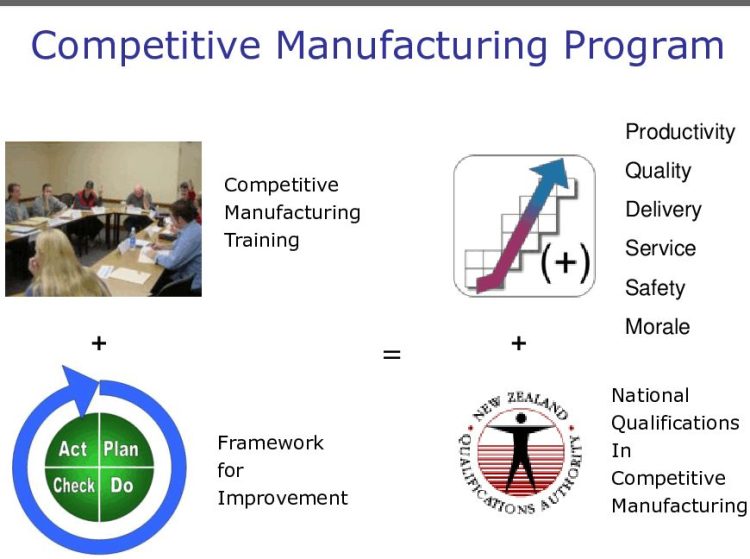
Competitive Manufacturing: Your Gateway to Operational Excellence
This training material, titled “Competitive Manufacturing” by Vishnu Rayapeddi, introduces the concept of Operational Excellence. It outlines a comprehensive programme designed to equip participants with the knowledge, tools, and methods to significantly improve workplaces, leading to nationally recognised certification. The core focus is on identifying and eliminating operational waste—such as defects, overproduction, and unnecessary motion—to achieve “World Class” business performance through increased cost-effectiveness, higher quality, and faster, more consistent production. The material details a structured change management model, emphasising the importance of defining changes, establishing Key Performance Indicators (KPIs), engaging stakeholders, and meticulously planning and monitoring implementation through various tools like Gantt Charts and Visual Management Systems. Ultimately, it aims to transform businesses by fostering a culture of continuous improvement and value creation for the customer.$ 59$ 69OpEx-Competitive Manufacturing
$ 59$ 69 -
GMP, Good Manufacturing Practices Training PPT
The provided document, “OpEx – GMP Modules All in One.pdf” by Vishnu Rayapeddi, serves as a comprehensive training manual on Good Manufacturing Practices (GMP). It systematically covers the fundamentals of GMP, defining its purpose as ensuring products are consistently manufactured to a quality appropriate for their intended use, ultimately leading to customer satisfaction. The manual meticulously details how GMP applies to people (training, health, hygiene, attitude), buildings (space, light, planned flow, environmental controls, maintenance), and systems (identification, double-checking, documentation). Furthermore, it elaborates on critical aspects like labelling, weighing, personal hygiene, and cleaning processes, emphasising the prevention of mix-ups, contamination, and product performance issues. Finally, the text explains how compliance is measured through internal and external audits, process control, customer complaints, and adherence to specifications and yield calculations, underlining the legal, corporate, and moral imperatives for following GMP.
$ 59$ 69