-
OpRx – Developing a Lean Culture
Develop a Lean Culture
The source, “OpEx – Develop a Lean Culture” by Vishnu Rayapeddi, argues that organisational culture is the most crucial element for business success, not just people. It highlights the high failure rate of Lean implementations, attributing these failures not to the Lean tools themselves, but to an unwillingness to change the underlying culture. The document defines culture, behaviour, and philosophy, and explains that a culture of continuous improvement, led by passionate and accountable leaders, is essential. It further asserts that employee engagement, fostered through meaningful work, development opportunities, and organisational alignment, is the primary driver for successful cultural transformation and achieving desired business outcomes, with Lean tools serving as mere enablers rather than the solution itself.$ 39$ 44OpRx – Developing a Lean Culture
$ 39$ 44 -
OpEx – Standardised Work
OpEx: Standard Work
The source, titled “OpEx – Standard Work” by Vishnu Rayapeddi, introduces Standard Work as a foundational element for achieving operational excellence in organisations. It explains that Standard Work, originating from the Toyota Production System, involves establishing agreed-upon, reliable procedures for tasks, leading to improved safety, quality, and efficiency while reducing waste and cost. The document outlines four steps to implementing Standard Work, including creating various charts, and stresses the importance of clear communication, user-friendly manuals, and regular revisions. Furthermore, it discusses the application of Standard Work in mistake-proofing and standardised training through the Training Within Industry (TWI) method, which encompasses Job Instruction (JI), Job Methods (JM), and Job Relations (JR). Finally, the source highlights the concept of Leader Standard Work, advocating for a process-dependent management system to ensure consistent leadership practices.$ 39$ 44OpEx – Standardised Work
$ 39$ 44 -
PRINCE2 7th Edition Planner MS Templates Download – Both Microsoft Project MPP msp & ms Excel and Word Formats – Prince2
PRINCE2 7th Edition MS Templates Download – Microsoft Project MPP msp ms Excel and Word Formats – Prince2 Template Toolkit
$ 40$ 50 -

Database-Driven KPI Dashboard Excel Template | Monthly YoY Analysis | Metric Analysis by Entering Data in a Database | Performance Report
Database-Driven KPI Dashboard
Streamline your KPI tracking with this Database-Driven KPI Dashboard Excel Template. Unlike standard templates, this tool allows you to enter data into a database, automatically calculating values and ratios for monthly and cumulative performance tracking. Easily compare your metrics against targets or analyze year-over-year (YoY) performance with dynamic charts and visualizations. Perfect for business professionals and owners looking for an intuitive way to track and compare key metrics. This template simplifies data entry, aggregates results, and provides actionable insights, making it a must-have for performance analysis.
For more details about the template, check the link below;
Content:
• Excel file compatible with Excel 2010 and higher (and with sample data)
• Professional Design
• Works both on Mac and Windows
• No installation needed. Ready to use
• Dashboard with charts
• Database-Driven KPI Dashboard Excel Template
• Easy to use
• 100% editable
• Excel file
• Instant download
• Friendly customer support for all your questions
License: Private Use (not for distribution or resale)
$ 40 -
OpEx – Optimize Product Costs
Optimizing Costs
This presentation, “OpEx – Optimise Cost,” by Vishnu Rayapeddi, outlines strategies for operational excellence focused on cost optimisation. It begins by explaining the importance of understanding customer needs and how they define quality, alongside methods for analysing cost and waste components. The document highlights various types of waste in manufacturing, such as defects, overproduction, and excessive motion, and offers practical exercises for identifying and reducing these costs. Furthermore, it introduces the concept of pull systems in production, contrasting them with traditional push systems to demonstrate their benefits in reducing operational costs and inventory. The presentation concludes by emphasising the importance of measuring results and implementing continuous improvement projects to achieve significant cost reductions and enhance customer satisfaction.$ 44$ 49OpEx – Optimize Product Costs
$ 44$ 49 -

Simple Financial Management Excel Template
This spreadsheet aims to help you record payments and receipts by month, view reports of payments and receipts, and a beautiful dashboard with indications.
$ 49 -
-
OpEx-Six Sigma – Improve Process Capability
Process Capability
This source outlines a three-session programme focused on determining and improving process capability, often associated with Six Sigma methodologies. The initial session introduces the process model, the relationship between Key Process Input Variables (KPIV) and Key Process Output Variables (KPOV), and the importance of measurements, including the concept of normal distribution and 3-Sigma vs 6-Sigma performance. Participants engage in an exercise using a catapult (X-Pult) to identify process variables and collect data. The second session reviews control charts, distinguishing between common cause and special cause variation, and explains process capability through the Cpk index. The final session concentrates on root cause analysis, developing improvement action plans, and implementing these changes, again using the catapult exercise to demonstrate measurable improvements in process capability.$ 49$ 54 -
OpEx – LSS, Lean Six Sigma Memory Jogger
This document offers a ready refresher with over 50 LSS topics / fundamentals1(30
slides) on Lean Six Sigma and other related best practice concepts. It includes
tools, templates, and checklists. You can also use these as 1 Point Lessons
$ 49$ 54 -
OpEx-5SVC-5S and Visual Controls
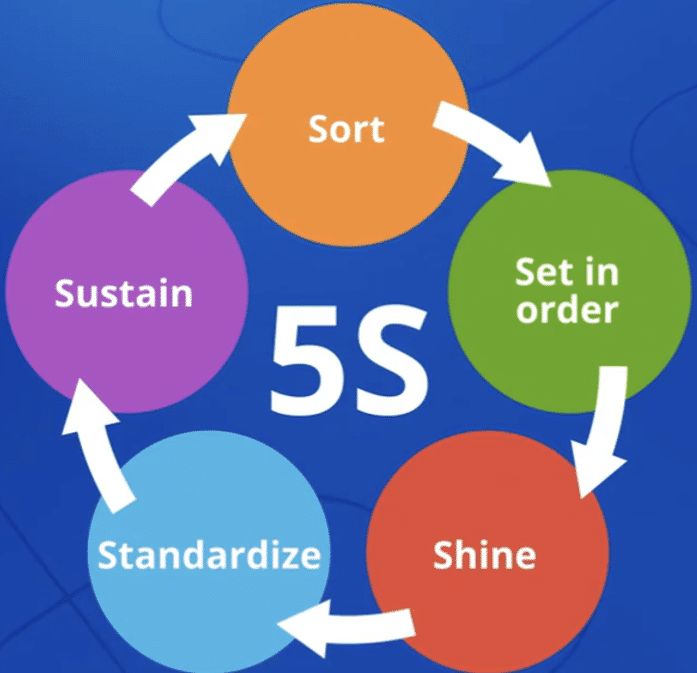
The source, titled “5S & Visual Controls for High Performance Workplace” by Vishnu Rayapeddi, outlines a comprehensive workshop focused on implementing the 5S methodology within an operational setting. This approach, originating from lean manufacturing principles, aims to create a safe, clean, and organised workplace to improve efficiency and quality. The document details each of the five “S” steps: Sort, Set-in-Order, Shine, Standardise, and Sustain, providing practical guidance, self-assessment tools, and examples for implementation. Ultimately, the objective is to achieve “World-Class Manufacturing” through disciplined workplace organisation and the effective use of visual controls and displays to communicate information and manage processes.
$ 54$ 64OpEx-5SVC-5S and Visual Controls
$ 54$ 64 -
GMP, Good Manufacturing Practices Training PPT
The provided document, “OpEx – GMP Modules All in One.pdf” by Vishnu Rayapeddi, serves as a comprehensive training manual on Good Manufacturing Practices (GMP). It systematically covers the fundamentals of GMP, defining its purpose as ensuring products are consistently manufactured to a quality appropriate for their intended use, ultimately leading to customer satisfaction. The manual meticulously details how GMP applies to people (training, health, hygiene, attitude), buildings (space, light, planned flow, environmental controls, maintenance), and systems (identification, double-checking, documentation). Furthermore, it elaborates on critical aspects like labelling, weighing, personal hygiene, and cleaning processes, emphasising the prevention of mix-ups, contamination, and product performance issues. Finally, the text explains how compliance is measured through internal and external audits, process control, customer complaints, and adherence to specifications and yield calculations, underlining the legal, corporate, and moral imperatives for following GMP.
$ 59$ 69