-
OpEx – SCM Fundamentals – Demand Forecasting
This source, titled “OpEx- SCM Funda2 Forecasting.pdf” by Vishnu Rayapeddi, provides an extensive overview of demand forecasting within supply chain management. It begins by defining forecasting as educated guessing and a crucial process for business decisions across various time horizons, from short-range (under one year) to long-range (over three years). The document details different types of forecasts, including economic, technological, and demand, and outlines seven key steps in the forecasting process, from determining its use to validating results. Furthermore, the text distinguishes between qualitative forecasting methods (like the Delphi method and sales force composite) and quantitative methods (such as moving averages, exponential smoothing, and linear regression), explaining their applications and calculations, including metrics like Mean Absolute Deviation (MAD) and tracking signals for monitoring forecast accuracy.
$ 34$ 39 -
OpEx – SCM Fundamentals – MRP-Materials Requirement Planning
The source “OpEx-SCM Funda4 MRP.pdf” provides an overview of Materials Requirement Planning (MRP), a crucial component of supply chain management. It begins by distinguishing dependent versus independent demand and details the planning process that leads to Material Requirements Planning. The document explains Bills-of-Material (BOM), including different types like modular and phantom bills, and outlines the structure and benefits of an MRP system. Furthermore, it explores extensions of MRP, such as Closed Loop MRP, Capacity Planning, Manufacturing Resource Planning (MRP II), Enterprise Resource Planning (ERP), and Distribution Resource Planning (DRP), illustrating the evolution of these systems and their applications in both manufacturing and service sectors.
$ 24$ 29 -
OpEx – SSGB, Six Sigma Green Belt Training PPT
This text provides a comprehensive overview of Operational Excellence and Six Sigma methodologies, detailing their importance in enhancing business profitability, customer satisfaction, and market competitiveness. It introduces key quality management gurus like Deming, Juran, Crosby, Ishikawa, and Taguchi, outlining their foundational philosophies and contributions to quality improvement. The document then thoroughly explores the Six Sigma project lifecycle, from defining and measuring processes to analysing root causes, implementing solutions, and establishing robust control plans. Crucially, it integrates concepts of stakeholder management, financial analysis, and various data collection and analysis tools essential for successful Six Sigma implementatio
$ 249$ 269 -
OpEx – Standardised Work
OpEx: Standard Work
The source, titled “OpEx – Standard Work” by Vishnu Rayapeddi, introduces Standard Work as a foundational element for achieving operational excellence in organisations. It explains that Standard Work, originating from the Toyota Production System, involves establishing agreed-upon, reliable procedures for tasks, leading to improved safety, quality, and efficiency while reducing waste and cost. The document outlines four steps to implementing Standard Work, including creating various charts, and stresses the importance of clear communication, user-friendly manuals, and regular revisions. Furthermore, it discusses the application of Standard Work in mistake-proofing and standardised training through the Training Within Industry (TWI) method, which encompasses Job Instruction (JI), Job Methods (JM), and Job Relations (JR). Finally, the source highlights the concept of Leader Standard Work, advocating for a process-dependent management system to ensure consistent leadership practices.$ 39$ 44OpEx – Standardised Work
$ 39$ 44 -
OpEx – The Lean Office
Lean Thinking for Office and Admin Areas
This document, “OpEx_Lean_Office.pdf,” is a presentation by Vishnu Rayapeddi from Productivity Solutions (PSL) on Lean Thinking for Office & Admin Areas, copyrighted in 2011. It serves as a gateway to operational excellence, detailing various best-class practices such as Lean, Six Sigma, Total Quality Management (TQM), and the Theory of Constraints (TOC). The presentation’s core focuses on defining operational excellence and the elimination of waste through structured approaches like the Toyota Production System (TPS). It outlines a three-part methodology to “Lean your Business”: stabilise processes, standardise processes, and simplify processes, with practical tools and activities for each stage. The document ultimately aims to foster a continuous improvement culture within organisations to enhance productivity and reduce costs.$ 69$ 74OpEx – The Lean Office
$ 69$ 74 -
OpEx-5SVC-5S and Visual Controls
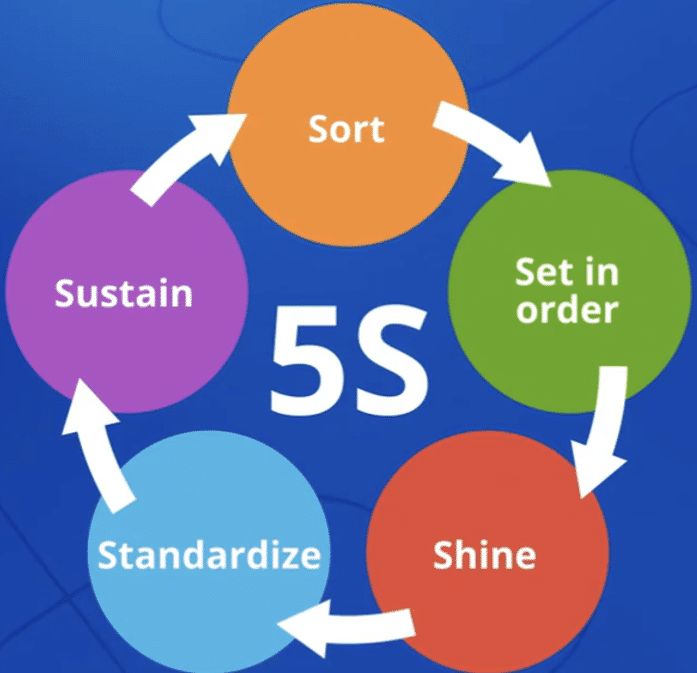
The source, titled “5S & Visual Controls for High Performance Workplace” by Vishnu Rayapeddi, outlines a comprehensive workshop focused on implementing the 5S methodology within an operational setting. This approach, originating from lean manufacturing principles, aims to create a safe, clean, and organised workplace to improve efficiency and quality. The document details each of the five “S” steps: Sort, Set-in-Order, Shine, Standardise, and Sustain, providing practical guidance, self-assessment tools, and examples for implementation. Ultimately, the objective is to achieve “World-Class Manufacturing” through disciplined workplace organisation and the effective use of visual controls and displays to communicate information and manage processes.
$ 54$ 64OpEx-5SVC-5S and Visual Controls
$ 54$ 64 -
OpEx-Quality, Problem Solving & Root Cause Analysis (RCA)
Problem Solving
The provided document, “OpEx – Quality & Problem Solving” by Vishnu Rayapeddi, offers a comprehensive guide to achieving operational excellence through effective quality management and problem-solving methodologies. It introduces the core concept of Zero Quality Control (ZQC), which aims for zero defects by preventing errors from becoming flaws, highlighting its importance for customer satisfaction and cost control. The text details various inspection approaches, contrasting traditional methods with ZQC’s source inspection, 100% inspection, short feedback loops, and mistake-proofing (Poka-Yoke). Furthermore, the document outlines a 5-step problem-solving method, incorporating tools like PDCA (Plan-Do-Check-Act), Fishbone Diagrams, Pareto Charts, Flow Charts, and Brainstorming techniques to identify root causes and implement continuous improvements.$ 29$ 34 -
OpRx – Developing a Lean Culture
Develop a Lean Culture
The source, “OpEx – Develop a Lean Culture” by Vishnu Rayapeddi, argues that organisational culture is the most crucial element for business success, not just people. It highlights the high failure rate of Lean implementations, attributing these failures not to the Lean tools themselves, but to an unwillingness to change the underlying culture. The document defines culture, behaviour, and philosophy, and explains that a culture of continuous improvement, led by passionate and accountable leaders, is essential. It further asserts that employee engagement, fostered through meaningful work, development opportunities, and organisational alignment, is the primary driver for successful cultural transformation and achieving desired business outcomes, with Lean tools serving as mere enablers rather than the solution itself.$ 39$ 44OpRx – Developing a Lean Culture
$ 39$ 44 -

Orchard Excel Financial Model
This Excel-based financial model provides a comprehensive 50-year forecast for an apple or any type of orchard. It includes detailed assumptions for planting, harvesting, operating costs, capital expenditures, and financing, generating full 3-statement financial projections, executive summary, and discounted cash flow analysis.
$ 45 -

Organic Liquid Fertilizer Plant – 10 Year Financial Model
10-Year Financial Model for an Organic Liquid Fertilizer Plant, forecasting revenue, production costs, and cash flow based on output capacity, raw material sourcing (such as animal waste or plant-based inputs), pricing, and distribution. The model helps evaluate profitability, break-even points, and return on investment, guiding strategic decisions on scaling, pricing strategy, and market expansion.
$ 139 -
P2P Investing Model
This Excel-based P2P investing model allows users to project returns on peer-to-peer lending investments over a 55-year timeframe. It includes features for monthly compounding, cash drag adjustments, deposit/withdrawal tracking, weighted average return calculation, and visual analysis.
$ 75P2P Investing Model
$ 75 -

Pareto Analysis
This Excel-based Pareto Analysis template provides a dynamic tool for identifying and prioritizing key areas of improvement across various business functions. It features automated data ordering, conditional formatting, and visual charts to facilitate clear and actionable insights.
$ 45Pareto Analysis
$ 45