-
Operations KPI Dashboard Excel Template | Spreadsheet for Business Management | Performance Tracking | Editable Operations KPI Dashboard
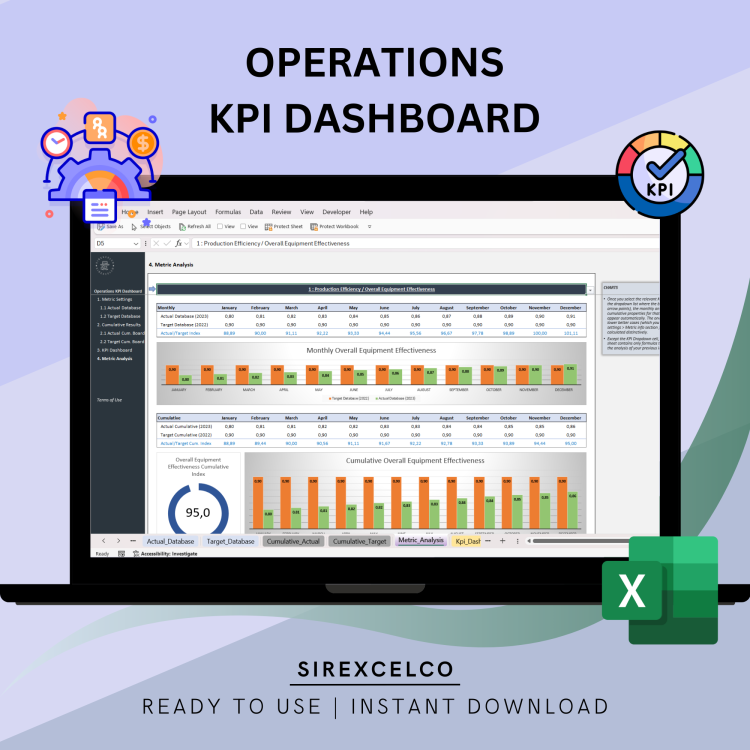
This Operations KPI Dashboard Excel Template is perfect for tracking and visualizing your business performance metrics.
For more details about the template, check the link below;
Whether you’re managing a small business or a large enterprise, this customizable Excel dashboard helps you monitor key performance indicators (KPIs) in real-time. With easy-to-use formulas and pre-built charts, you can efficiently track and analyze data to make informed decisions. Download this template today and take control of your business analytics with a professional, user-friendly tool.
Content:
• Excel file compatible with Excel 2010 and higher (and with sample data)
• Professional Design
• Works both on Mac and Windows
• No installation needed. Ready to use
• Dashboard with charts
• Operations KPI Dashboard
• Easy to use
• 100% editable
• Excel file
• Instant download
• Friendly customer support for all your questions
License: Private Use (not for distribution or resale)
$ 35 -
OpEx – Inventory Management
This source provides an extensive overview of inventory management within supply chain fundamentals. It introduces Vishnu Rayapeddi as the author, highlighting their significant experience and qualifications in the field. The text thoroughly defines inventory and inventory management, outlining key objectives such as customer service and cost minimisation. Various types of inventory are explored, alongside the costs associated with inventory, including holding, ordering, and shortage costs. The document also differentiates between independent and dependent demand and explains various order quantity strategies, focusing on the Economic Order Quantity (EOQ) model and the Quantity Discount Model, complete with practical examples. Furthermore, it details ABC analysis for inventory categorisation, its procedural steps, and implications for inventory management policies, including cycle counting and different inventory valuation methods like FIFO, LIFO, and Weighted Average. Finally, the text briefly touches upon Kanban systems as a method for production control.
$ 39$ 44OpEx – Inventory Management
$ 39$ 44 -
OpEx – Kaizen, Continuous Improvement
Facilitating Kaizen
The provided document, “OpEx-Facilitate CI-Kaizen.pdf” by Vishnu Rayapeddi, introduces Kaizen, a Japanese concept meaning gradual and orderly continuous improvement. It outlines a structured approach to fostering an organisational culture of sustained improvement by eliminating waste through various activities. The text highlights different types of Kaizen activities, including “Quick and Easy Kaizen” for daily small improvements and “Kaizen Events” (also known as “Kaizen Blitz”) for targeted, accelerated improvements. The Plan-Do-Check-Act (PDCA) cycle is presented as the core process for continuous improvement, emphasising the importance of standardising new processes to prevent regression. The document also details the planning, implementation, and follow-up phases for Kaizen events, suggesting a comprehensive framework for achieving operational excellence.$ 39$ 44 -
OpEx – Lean JIT Kanban Systems
Kanban System Implementation
This source, titled “OpEx-KanbanSystems.pdf” by Vishnu Rayapeddi, provides a comprehensive overview of Kanban implementation within operational excellence frameworks. It explores the historical origins of Kanban from its roots in Toyota’s production system to its purpose in modern manufacturing. The document details the mechanics of Kanban, including visual systems, planning and scheduling integration, and various types such as withdrawal, production, and signal Kanbans. Furthermore, it highlights the significant benefits of adopting a Kanban system, such as inventory reduction and improved flow, and offers a seven-step guide to successful implementation, concluding with a practical case study for calculating Kanban numbers.$ 39$ 44OpEx – Lean JIT Kanban Systems
$ 39$ 44 -
OpEx – Lean JIT, Just In Time
Developing a Just in Time System
This resource, “Develop a Just in Time System” by Vishnu Rayapeddi, offers a comprehensive guide to implementing Just-in-Time (JIT) operational strategies. It begins by defining JIT as a system that ensures products are delivered precisely when and where they are needed, highlighting its benefits such as reduced costs and increased customer satisfaction. The material then explores the distinction between push and pull systems for creating product flow, advocating for the latter’s efficiency in lowering inventory. Key performance indicators like Takt Time, inventory turns, and DIFOTIS (Delivered in Full, On Time, In Spec) are introduced as crucial for monitoring success. The document further outlines various Kanban systems—including production, withdrawal, signal, multi-bin, and e-Kanban—as vital tools for managing material flow, along with CONWIP and FIFO systems. Finally, it presents a structured approach to implementing JIT through workplace projects, detailing evidence requirements for designing, implementing, and monitoring the system.$ 29$ 34OpEx – Lean JIT, Just In Time
$ 29$ 34 -
OpEx – Lean MBA 2-day workshop PPT
Operational Excellence: A Lean-MBA Framework
The provided document, “OpEx-Lean-MBA 2day.pdf” by Vishnu Rayapeddi, outlines a Lean MBA framework designed to achieve Operational Excellence (BizEx). It introduces Business Excellence as outperforming competitors in key operational dimensions like quality, cost, and delivery, and continuously improving fundamental systems and customer satisfaction. The framework incorporates various best practices, including Total Quality Management (TQM), Six Sigma, Theory of Constraints (TOC), and the Toyota Production System (TPS), aiming to simplify processes, enhance quality, and increase competitiveness. The text details essential Lean tools such as Value Stream Mapping (VSM), 5S methodology, Total Productive Maintenance (TPM), Standardised Work, Kaizen, and Pull Systems, explaining their purpose and implementation for waste elimination and efficiency gains. Ultimately, the document serves as a comprehensive guide for organisations seeking to foster a culture of continuous improvement and achieve world-class operational performance.$ 109$ 119OpEx – Lean MBA 2-day workshop PPT
$ 109$ 119 -
OpEx – SCM Fundamentals – Demand Forecasting
This source, titled “OpEx- SCM Funda2 Forecasting.pdf” by Vishnu Rayapeddi, provides an extensive overview of demand forecasting within supply chain management. It begins by defining forecasting as educated guessing and a crucial process for business decisions across various time horizons, from short-range (under one year) to long-range (over three years). The document details different types of forecasts, including economic, technological, and demand, and outlines seven key steps in the forecasting process, from determining its use to validating results. Furthermore, the text distinguishes between qualitative forecasting methods (like the Delphi method and sales force composite) and quantitative methods (such as moving averages, exponential smoothing, and linear regression), explaining their applications and calculations, including metrics like Mean Absolute Deviation (MAD) and tracking signals for monitoring forecast accuracy.
$ 34$ 39 -
OpEx – SCM Fundamentals – MRP-Materials Requirement Planning
The source “OpEx-SCM Funda4 MRP.pdf” provides an overview of Materials Requirement Planning (MRP), a crucial component of supply chain management. It begins by distinguishing dependent versus independent demand and details the planning process that leads to Material Requirements Planning. The document explains Bills-of-Material (BOM), including different types like modular and phantom bills, and outlines the structure and benefits of an MRP system. Furthermore, it explores extensions of MRP, such as Closed Loop MRP, Capacity Planning, Manufacturing Resource Planning (MRP II), Enterprise Resource Planning (ERP), and Distribution Resource Planning (DRP), illustrating the evolution of these systems and their applications in both manufacturing and service sectors.
$ 24$ 29 -
OpEx – SSGB, Six Sigma Green Belt Training PPT
This text provides a comprehensive overview of Operational Excellence and Six Sigma methodologies, detailing their importance in enhancing business profitability, customer satisfaction, and market competitiveness. It introduces key quality management gurus like Deming, Juran, Crosby, Ishikawa, and Taguchi, outlining their foundational philosophies and contributions to quality improvement. The document then thoroughly explores the Six Sigma project lifecycle, from defining and measuring processes to analysing root causes, implementing solutions, and establishing robust control plans. Crucially, it integrates concepts of stakeholder management, financial analysis, and various data collection and analysis tools essential for successful Six Sigma implementatio
$ 249$ 269 -
OpEx – The Lean Office
Lean Thinking for Office and Admin Areas
This document, “OpEx_Lean_Office.pdf,” is a presentation by Vishnu Rayapeddi from Productivity Solutions (PSL) on Lean Thinking for Office & Admin Areas, copyrighted in 2011. It serves as a gateway to operational excellence, detailing various best-class practices such as Lean, Six Sigma, Total Quality Management (TQM), and the Theory of Constraints (TOC). The presentation’s core focuses on defining operational excellence and the elimination of waste through structured approaches like the Toyota Production System (TPS). It outlines a three-part methodology to “Lean your Business”: stabilise processes, standardise processes, and simplify processes, with practical tools and activities for each stage. The document ultimately aims to foster a continuous improvement culture within organisations to enhance productivity and reduce costs.$ 69$ 74OpEx – The Lean Office
$ 69$ 74 -
-
OpEx – VSM, Value Stream Mapping
Value Stream Mapping
The provided source, “OpEx – VSM.pdf” by Vishnu Rayapeddi, serves as a comprehensive guide to Value Stream Mapping (VSM), a critical component of Operational Excellence. It outlines an eight-step roadmap for implementing VSM, beginning with a commitment to lean principles and culminating in continuous improvement. The document explains how VSM helps visualise entire value streams, identify and eliminate non-value-adding activities (waste), and ultimately improve efficiency and customer satisfaction within manufacturing, administrative, and service sectors. Key concepts such as Takt Time, flow, pull systems, and levelling production are explored, providing practical methods for optimising processes and achieving significant cost reductions and$ 59$ 69OpEx – VSM, Value Stream Mapping
$ 59$ 69