
Ecommerce CAC & LTV Calculator
$ 60
The E-Commerce Unit Economics & CAC/LTV Calculator is designed to give e-commerce founders, operators, and investors a clear, data-driven view of customer acquisition efficiency and long-term customer value. Whether you are running a DTC brand, a Shopify store, an Amazon storefront, or a multi-channel retail operation, this model helps you answer the fundamental questions that drive sustainable growth:
• How much does it truly cost to acquire a customer across each marketing channel?
• What is the lifetime value of your customers, and how does it compare to acquisition cost?
• Which channels deliver the best return on ad spend and the healthiest unit economics?
• At what point does your business achieve CAC payback, and how does that change under different scenarios?
• How do changes in retention, average order value, and purchase frequency impact long-term profitability?
The model is built to be straightforward enough for founders evaluating their first marketing budget, yet robust enough for CFOs and investors conducting due diligence on customer economics. It bridges the gap between high-level KPI dashboards and detailed financial projections by providing a comprehensive, assumption-driven framework.
What Is the Model For?
The E-Commerce Unit Economics & CAC/LTV Calculator is designed to give e-commerce founders, operators, and investors a clear, data-driven view of customer acquisition efficiency and long-term customer value. Whether you are running a DTC brand, a Shopify store, an Amazon storefront, or a multi-channel retail operation, this model helps you answer the fundamental questions that drive sustainable growth:
• How much does it truly cost to acquire a customer across each marketing channel?
• What is the lifetime value of your customers, and how does it compare to acquisition cost?
• Which channels deliver the best return on ad spend and the healthiest unit economics?
• At what point does your business achieve CAC payback, and how does that change under different scenarios?
• How do changes in retention, average order value, and purchase frequency impact long-term profitability?
The model is built to be straightforward enough for founders evaluating their first marketing budget, yet robust enough for CFOs and investors conducting due diligence on customer economics. It bridges the gap between high-level KPI dashboards and detailed financial projections by providing a comprehensive, assumption-driven framework.
What Is Included in the Template?
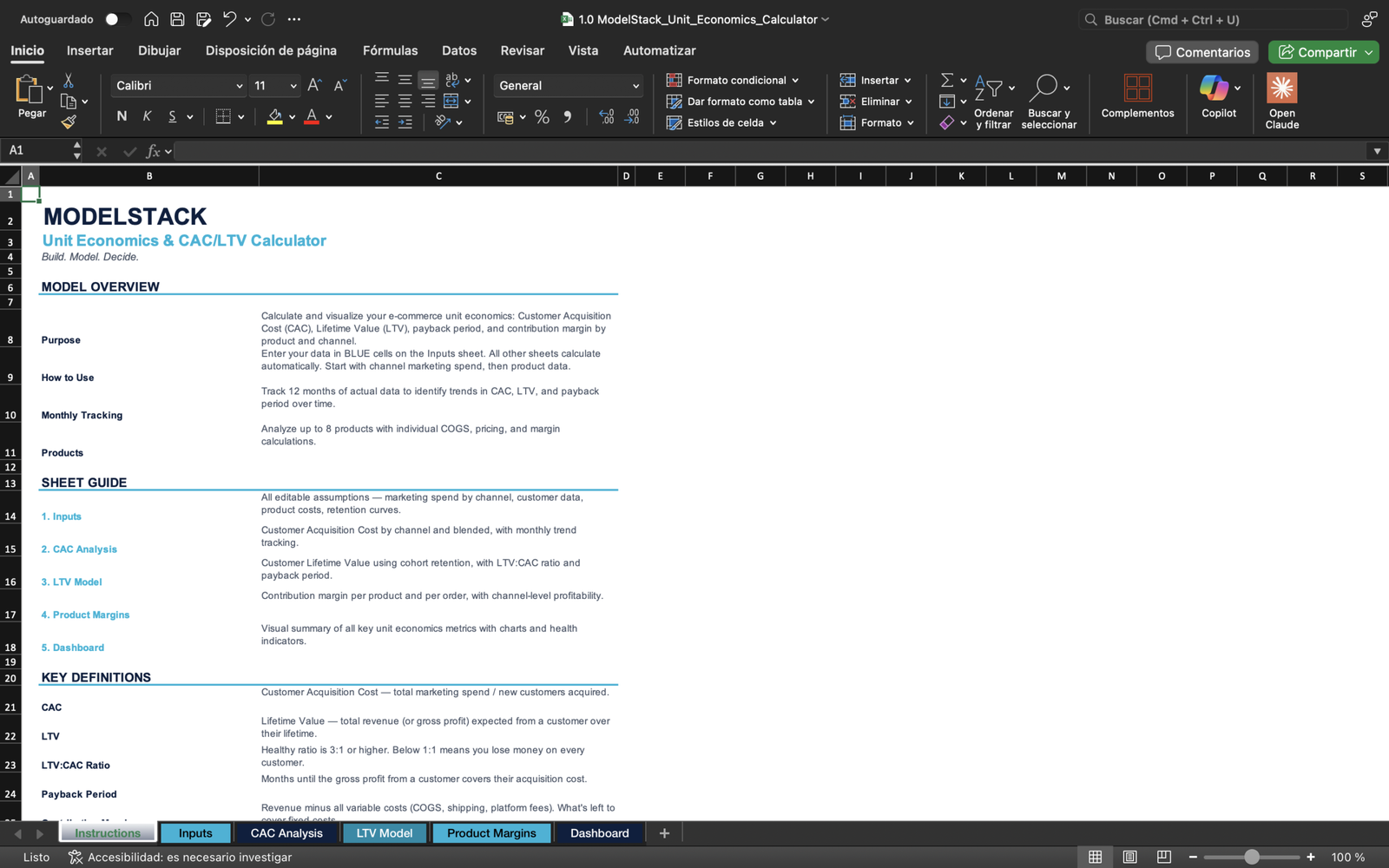
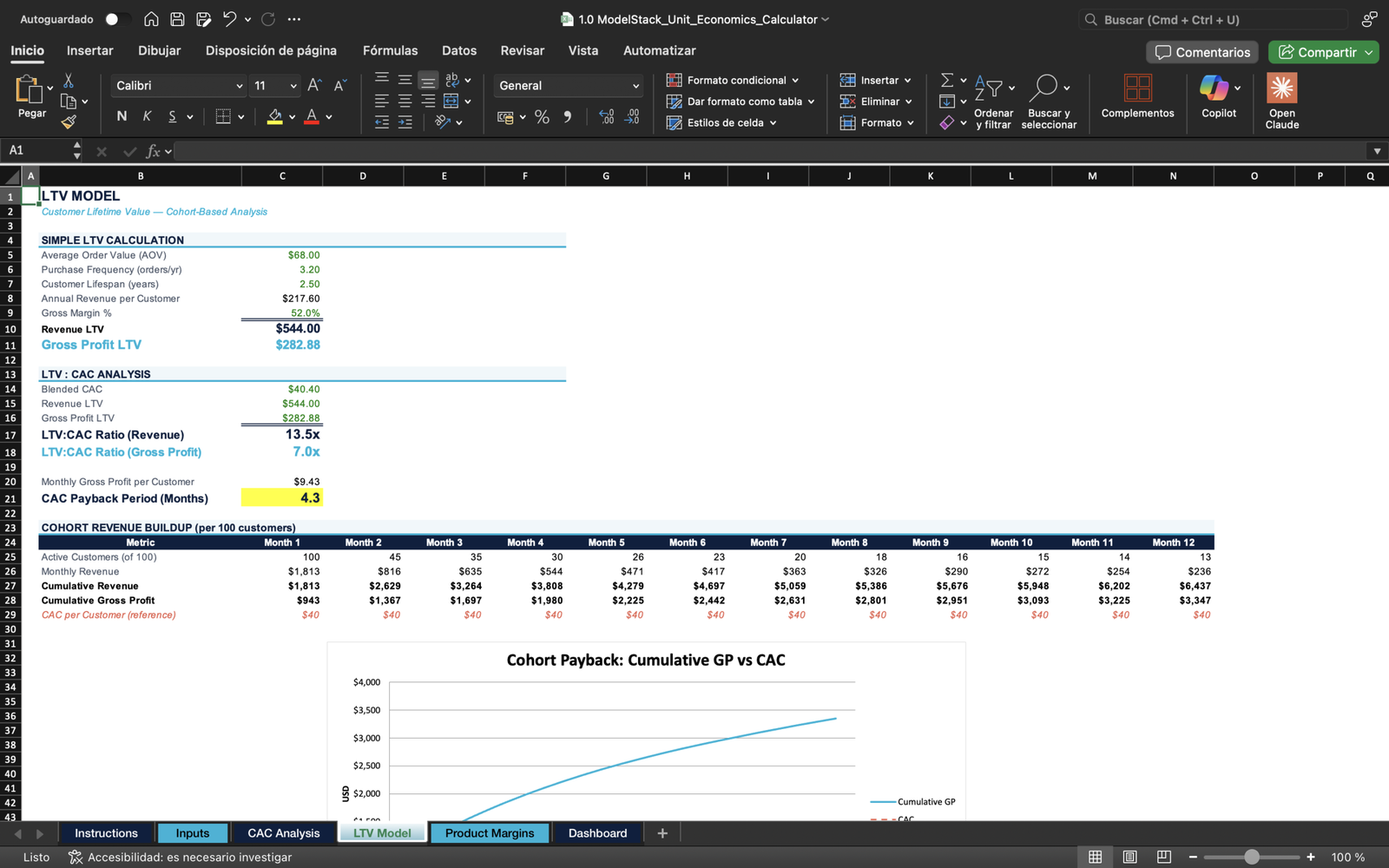
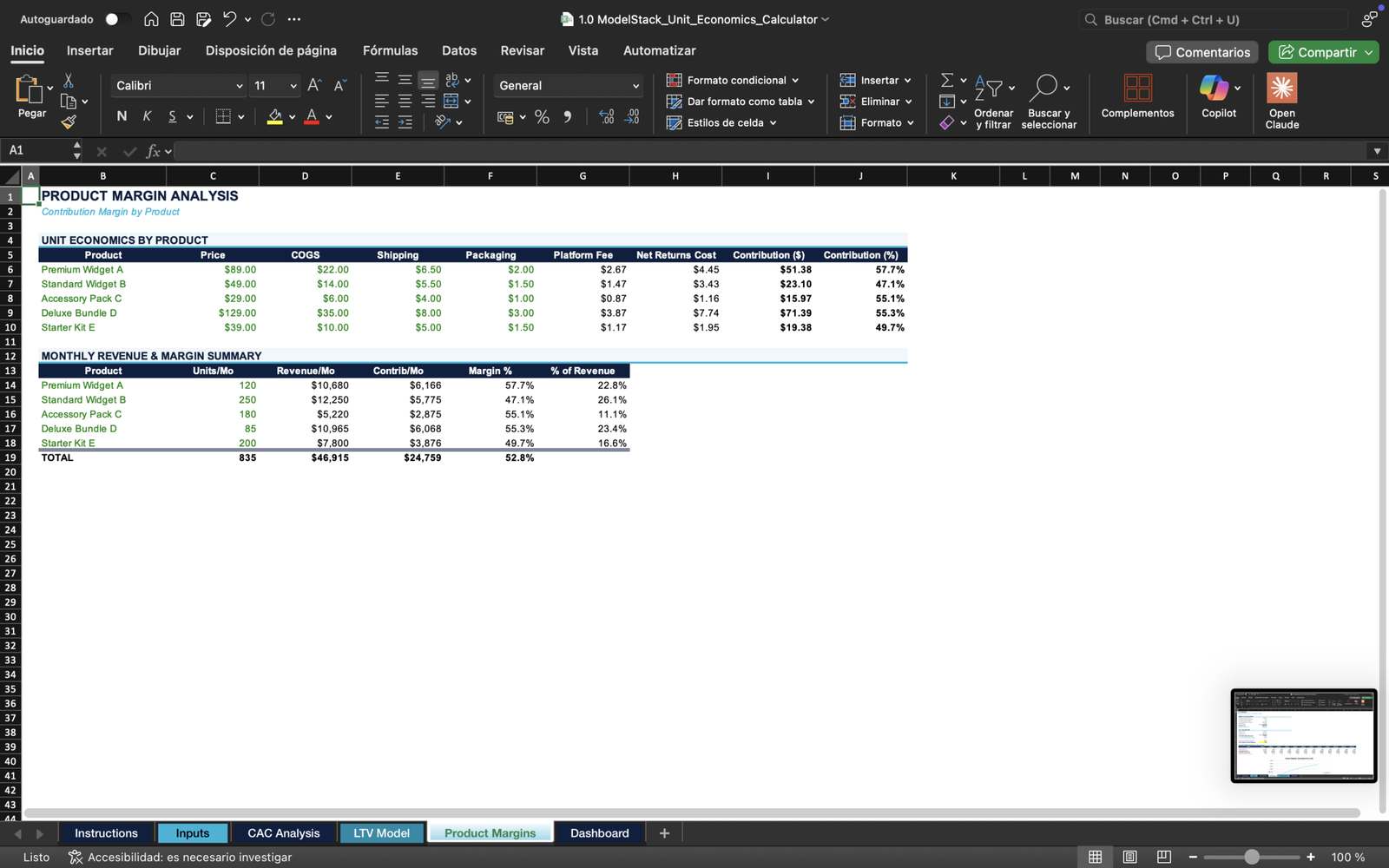
The template is organized across multiple integrated tabs, each designed to address a specific dimension of your e-commerce unit economics. Together, they provide a complete picture from raw acquisition costs through to long-term customer value and profitability.
1. Dashboard
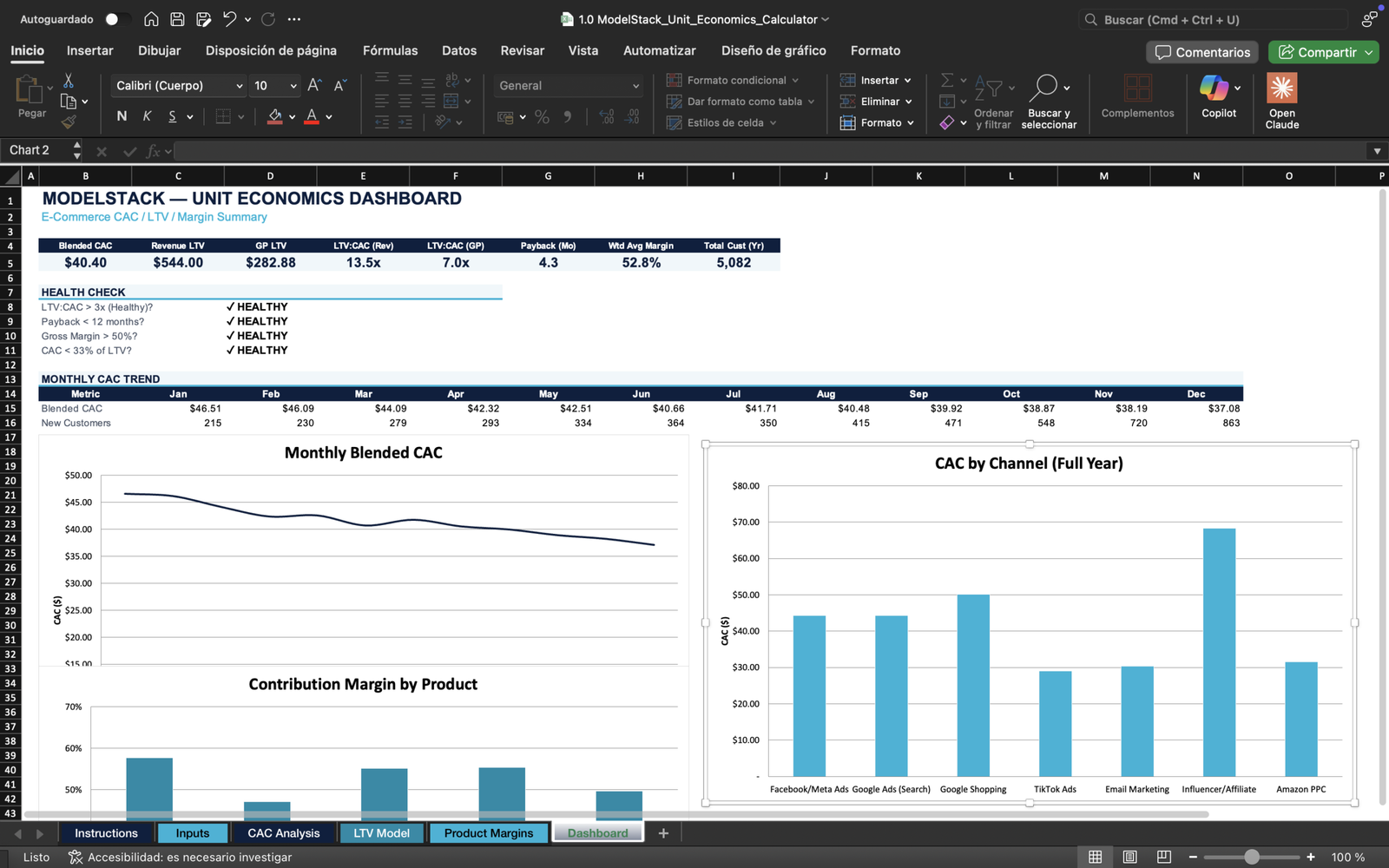
The Dashboard tab provides an executive-level summary of all key metrics in a single view. You will find dynamic charts and KPI cards displaying your blended CAC, customer LTV, LTV:CAC ratio, CAC payback period, and channel-level performance comparisons. A scenario toggle allows you to switch between Base, Optimistic, and Conservative cases to instantly see how your unit economics shift under different assumptions. This tab is designed to be presentation-ready for investor meetings, board decks, and internal strategy reviews.
2. Customer Acquisition
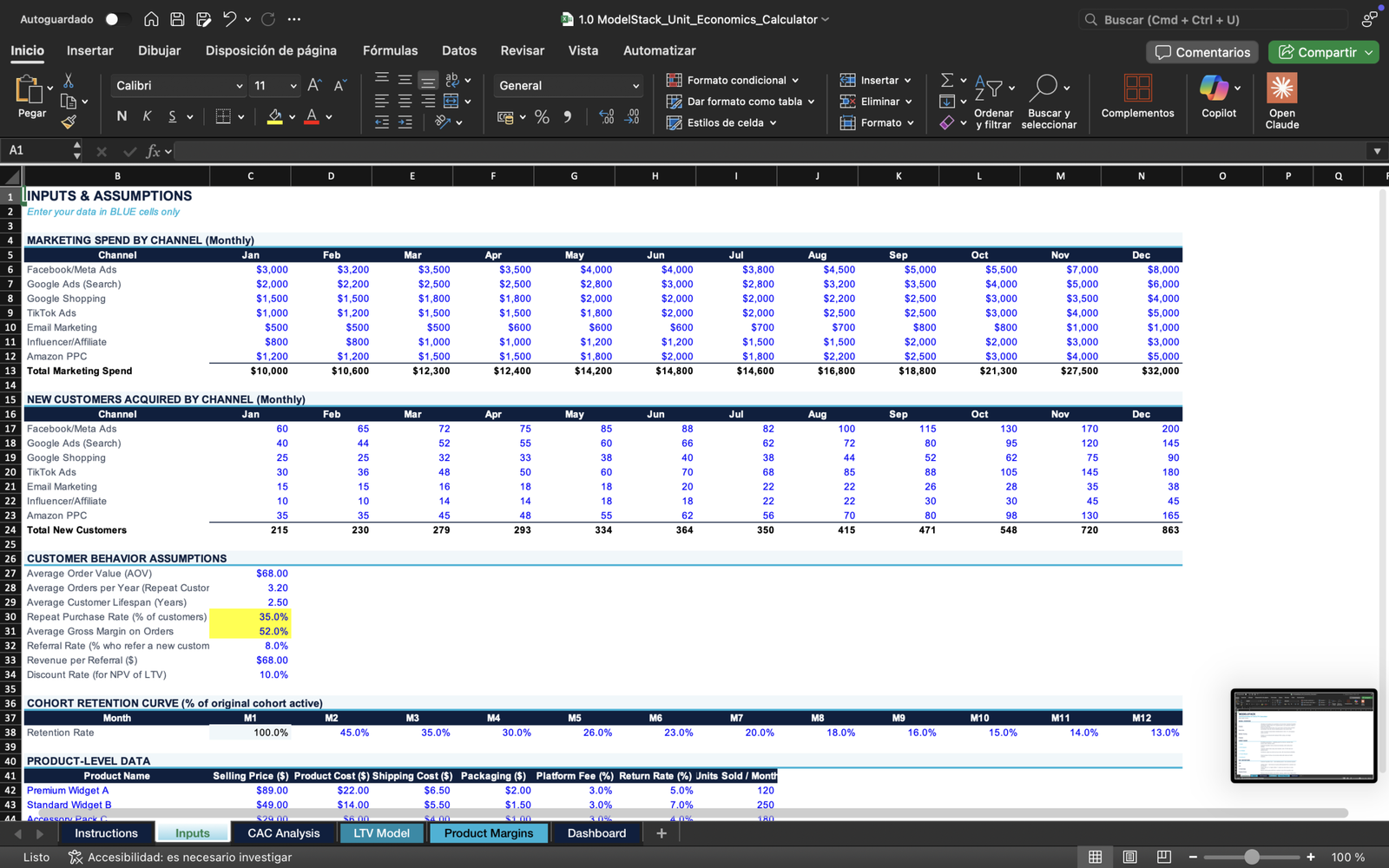
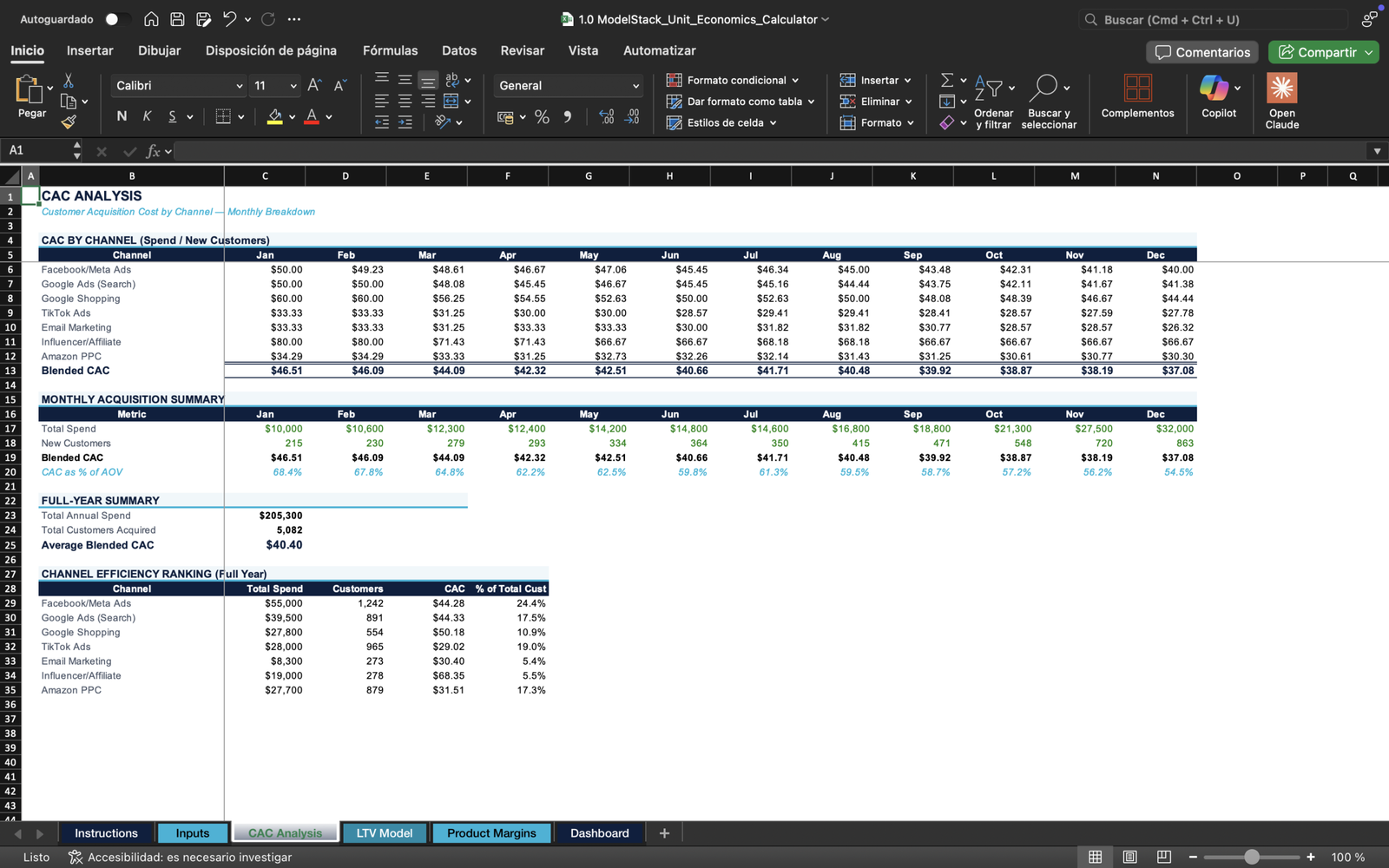
The Customer Acquisition tab is where you input your marketing spend and performance data across all channels. The model supports up to eight configurable acquisition channels, including paid social (Meta, TikTok), paid search (Google, Bing), email marketing, affiliate/referral, organic/SEO, influencer partnerships, marketplace advertising, and a custom channel. For each channel, you can input monthly ad spend, impressions, clicks, click-through rates, conversion rates, and the resulting number of new customers acquired. The model then calculates your cost-per-click (CPC), cost-per-acquisition (CPA), and channel-specific CAC automatically. A blended CAC metric aggregates performance across all channels, weighted by spend allocation.
3. Customer Lifetime Value
The LTV tab models the long-term revenue and margin contribution of your customer base. You will input your average order value (AOV), purchase frequency, gross margin percentage, and customer retention rate (or churn rate). The model calculates LTV using both the simple formula approach (AOV × Purchase Frequency × Customer Lifespan × Gross Margin) and a discounted cash flow approach that accounts for the time value of money using a configurable discount rate. A cohort-based retention curve allows you to model declining retention over time for greater accuracy, rather than relying on a flat retention assumption.
4. Unit Economics Analysis
This tab brings together the acquisition and lifetime value calculations into a unified profitability view. Key outputs include the LTV:CAC ratio (with benchmarks for healthy, breakeven, and unsustainable thresholds), CAC payback period in months, contribution margin per customer, and return on ad spend (ROAS) by channel. A sensitivity table shows how changes in your two most critical drivers—retention rate and AOV—impact the LTV:CAC ratio across a matrix of scenarios. This is particularly useful for identifying the assumptions that matter most to your business case.
5. Scenario Analysis
The Scenario Analysis tab allows you to define three complete scenarios (Base, Optimistic, and Conservative) with distinct assumptions for growth rates, ad spend, conversion efficiency, retention, and pricing. Each scenario generates its own full set of unit economics outputs, which feed back into the Dashboard for side-by-side comparison. This tab is essential for investor presentations, strategic planning, and stress-testing your business model against market volatility.
6. Monthly Projections
The Monthly Projections tab extends your unit economics analysis across a 24-month horizon. It projects monthly customer acquisition volumes, cumulative customer base, revenue per cohort, marketing spend, and net contribution by channel. This tab helps you visualize the trajectory of your customer economics over time and identify the inflection point where your business transitions from CAC-heavy investment to LTV-driven profitability. Seasonality adjustments can be applied to reflect peak shopping periods such as Black Friday, holiday seasons, and promotional events.
Key Features Summary
|
Feature |
Description |
|
Multi-Channel CAC |
Track acquisition costs across up to 8 marketing channels with automatic blended CAC calculation. |
|
Dual LTV Methodology |
Calculate customer lifetime value using both simple and discounted cash flow approaches. |
|
Cohort Retention Curves |
Model declining retention over time for realistic LTV projections beyond flat-rate assumptions. |
|
LTV:CAC Sensitivity Matrix |
Two-variable sensitivity table showing impact of retention and AOV changes on your key ratio. |
|
3-Scenario Toggle |
Switch between Base, Optimistic, and Conservative scenarios across all tabs with a single control. |
|
24-Month Projections |
Monthly forecasts with seasonality adjustments for customer acquisition, revenue, and contribution margin. |
|
ROAS by Channel |
Return on ad spend calculated per channel to optimize your marketing budget allocation. |
|
CAC Payback Period |
Automatically calculates the number of months to recover customer acquisition investment. |
|
Presentation-Ready Dashboard |
Executive-level charts and KPI cards suitable for investor meetings, board decks, and strategic reviews. |
|
Integrated Instructions |
In-model guidance on every tab to help you populate assumptions quickly and accurately. |
Who Is This Model For?
• E-commerce founders and operators who need to understand their customer acquisition efficiency and optimize marketing spend across channels.
• DTC brand managers evaluating which channels to scale, which to cut, and where the highest-ROI growth opportunities are.
• Startup founders preparing investor-ready materials that demonstrate a clear path to unit-economics profitability.
• CFOs and FP&A teams building bottom-up customer economic models to support budgeting and strategic planning decisions.
• Investors and analysts conducting due diligence on e-commerce businesses, assessing customer quality and acquisition sustainability.
How to Use This Model
Getting started with the model takes just a few minutes:
• Step 1: Begin on the Customer Acquisition tab. Input your current or projected marketing spend, impressions, clicks, and conversions for each active channel.
• Step 2: Move to the Customer Lifetime Value tab. Enter your average order value, purchase frequency, gross margin, and retention rate assumptions.
• Step 3: Review the Unit Economics Analysis tab for your LTV:CAC ratio, payback period, and channel-level ROAS.
• Step 4: Configure your three scenarios on the Scenario Analysis tab to stress-test assumptions and prepare for different market conditions.
• Step 5: Use the Dashboard for presentations and the Monthly Projections tab for operational planning.
General Inquiries
There are no inquiries yet.


Reviews
There are no reviews yet.