The Concept of Waste in Traditional Manufacturing
Are you aware that 95% of all the activities undertaken by traditional manufacturing businesses do not add any value OR in other words a waste??? Waste elimination is the central theme of Lean manufacturing. So, what is waste? Waste is defined as anything that does NOT add value from a customer perspective or the customer is not prepared to pay for.
The Three Categories of Business Activities
If we carefully analyse all the activities of a business, we can categorise them in to 3 types:
- Value-Adding activities (VA): Those which directly add value to a product or service.
- Non-Value Adding but Required (NVA-R): Activities that do not directly contribute towards a product or service, but have to be undertaken for legal requirements or to comply with certain regulatory bodies etc.
- Non-Value Adding activities (NVA): Also known as “muda,” the Japanese term for waste; these activities do not add any value at all.
Introduction to Value Stream Mapping (VSM)
Value Stream Mapping or in short VSM is one of the most important concepts of Lean Manufacturing which helps businesses in identifying the waste(s) thereby identifying opportunities for improvement and make plans to improve the flow by eliminating waste and hence reducing total lead time.
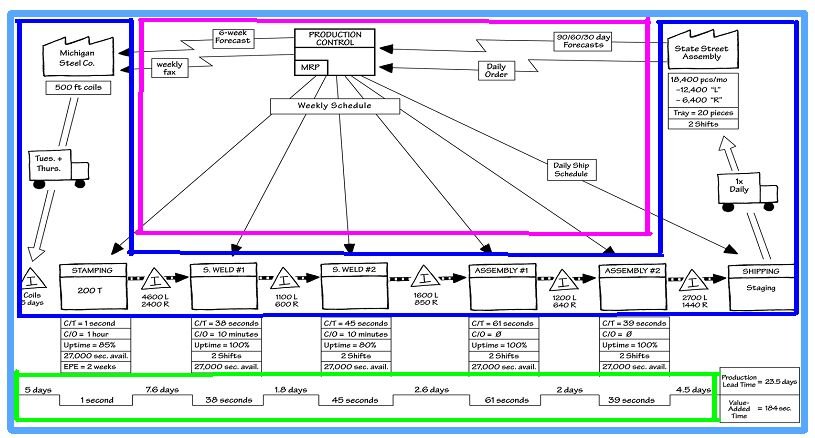
So, what is VSM? It consists of mapping all activities or process steps involved in both material flow and information flow and analysing all steps and identifying the wastes associated. At the bottom of the VSM, a value adding analysis is done to calculate the % of value added activities. It will be surprising to see that, most businesses will have a value adding % of below 5. Obviously there are some exceptions depending on the industry you are in. The challenge is to eliminate or minimise as much of waste or non-value adding steps so that the % of value addition goes up and this we call as productivity improvement, as the efforts which were wasted earlier will be used for adding value. This process can be applied to any process, including manufacturing, supply chain or services.
A Value Stream is defined as the set of all actions (both value added and non-value added) required in bringing a specific product or service from raw material through to the customer.
The 8 Steps of Value Stream Management
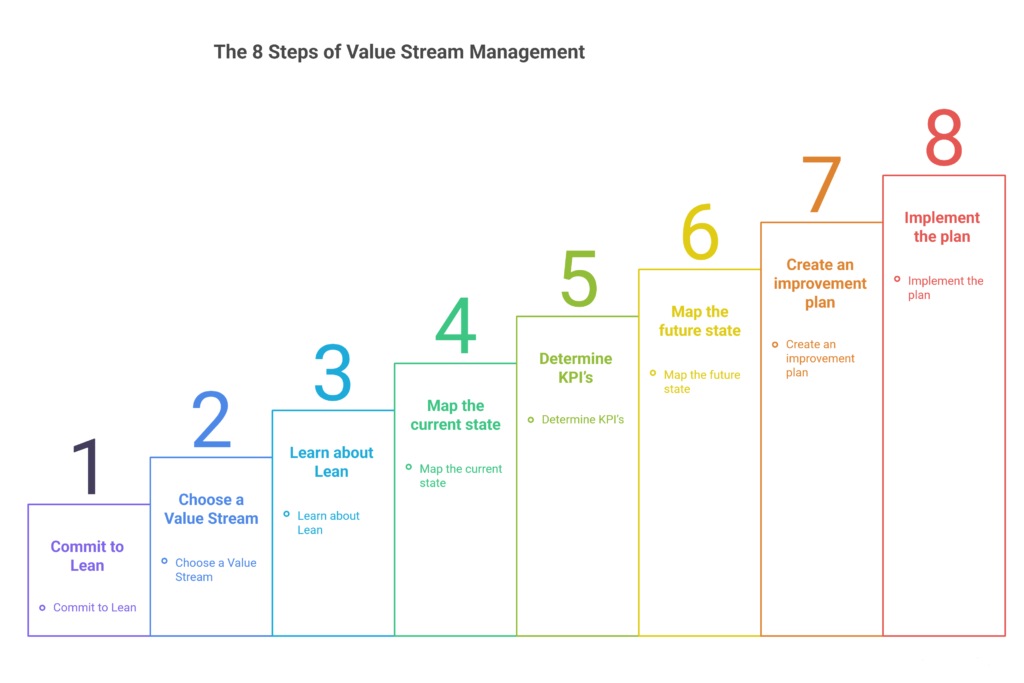
- Commit to Lean
- Choose a Value Stream
- Learn about Lean
- Map the current state
- Determine KPI’s
- Map the future state
- Create an improvement plan
- Implement the plan
A value stream could be simply a product (if the business produces just a handful of products) or a family of products which go through the same sequence of operations and the same resources.
Mapping the Current State
The best way to draw a VSM is to take a walk on the plant floor by identifying all steps involved (do not use standard set of data as you may be surprised to see what else happens there), and by challenging every step. Many steps are only necessary because of the way firms are organised and previous decisions about assets and technologies. Begin at the shipping end and walk upstream; collect the data such as Cycle times, changeover times, WIP, value-adding time, uptime of machines, transportation, scrap rate, first pass yield, material travel distance etc.
Draw a current state map using VSM icons. Draw using paper and pencil or use a white board as you will make numerous changes. Once the material and information flows have been drawn, identify the 8 types of wastes, and then calculate value-adding and non-value adding times for each step of the process. Finally, calculate the % of value-adding by dividing the value-adding time by the total lead time.
Designing the Future State and Continuous Improvement
Once you have identified the waste(s), it is a question of eliminating it or minimising it. Draw a future state map to show an improved process. The future state map is the next ideal state, but doesn’t mean that it will be the perfect one. As George Koenigsaecker points out in the video, “What Lean Means”, waste is like an onion having many layers and one can not see all the layers of waste in one go. Peel or eliminate one layer of waste, you will be able to see the next layer. You peel the next layer and you will see the next layer below and so on. The more you do, the better you get at it and it is all about Kaizen or Continuous Improvement.
VSM is used to reduce the total lead time, i.e., from the time customer places an order to the time the product or service is delivered, by introducing a smooth process flow which helps in matching the pace of demand with the pace of production, so that you are not producing too much or too less. You can create cells to improve work flow, introduce Kanban systems to reduce WIP, or improve the uptime of equipment by reducing changeover times etc. All the opportunities identified will become projects on their own and you need to set up task teams to work on these projects to eliminate the wastes identified. When all the identified opportunity projects are complete, it is time to take stock of the then existing condition and looking at drawing the next future state map and so on. Please remember that, this is NOT a one time activity. The more you do it the better your operations will be…i.e., Waste Free.