What Defines a Startup?
A startup is essentially a sprouting business brimming with fresh ideas aimed at introducing new products or services that disrupt traditional markets or create entirely new ones. These enterprises are characterized by their innovative approaches and aspirations for swift expansion, driven by groundbreaking visions and solutions.
How Startups Work: From Idea to Execution

Startups are dynamic, fast-paced entities designed to scale rapidly. They begin with a unique business idea, often filling a gap in the market or addressing specific needs of potential customers. The journey from concept to a thriving business involves several crucial steps, each requiring meticulous planning, robust strategy, and agile execution.
Step 1: Ideation and Conceptualization
Every startup begins with an idea. This could be a new product, technology, or service that offers a novel solution to a common problem. Founders must ensure their business idea is not only viable but also scalable. This means the idea should have the potential for growth without being restricted by resources or geography. At this stage, defining the business models, understanding the target market, and assessing growth potential are critical.
Step 2: Building the Business Framework
With a solid idea in place, the next step is to develop a comprehensive business strategy. This includes creating scalable business models and writing detailed business plans. Startup founders often seek input from business partners and venture capitalists during this phase. Financial investments are critical, as they provide the necessary capital to jump-start the business operations. Tools like business loans and venture capital are commonly explored for funding solutions.
Step 3: Assembling the Team
Startups need a robust team to bring their business idea to life. This team often includes a mix of startup owners, skilled professionals in technology and marketing, and sometimes a head of growth to oversee rapid scaling. A lean startup approach can be beneficial here, allowing the startup to remain agile and adaptable while keeping overhead low.
Step 4: Product Development and Testing
Product development is at the heart of startup operations. This phase involves turning the initial idea into a tangible product or service. Technology startups, for instance, will spend considerable time in the development and iterative testing of their tech offerings. The goal here is to refine the product based on feedback from early users and ensure it meets the market needs effectively.
Step 5: Market Launch and Growth Strategies
Launching the product into the market is a critical step that requires careful planning. The startup process includes marketing the product through various channels, establishing customer bases, and beginning to scale operations. Growth marketing strategies are employed to capture and expand the user base rapidly. This often involves digital marketing, social proof elements like user testimonials, and user engagement tactics.
Step 6: Monitoring, Scaling, and Expansion
Once the startup has successfully launched, the focus shifts to growth and expansion. Monitoring key metrics like user base growth, return on investment, and customer retention rates becomes pivotal. Scalable business models are put to the test as the startup expands. The ultimate aim for many is a public offering or acquisition by a larger company.
Step 7: Iteration and Continuous Improvement
The final ongoing step involves continuously refining the business model and product offerings based on market feedback and changing conditions. Successful startups remain flexible, adapting their strategies as they grow. Regular assessments of the business strategy, customer feedback, and market trends help the startup to innovate and stay competitive.
Understanding the Challenges of Startups

Navigating the Initial Stages
One of the primary challenges for startups, especially in their initial stages, is establishing a sustainable business model that allows for scalability and growth. The journey from an early-stage company to a successful business is fraught with potential hurdles, from securing adequate capital to refining the business idea into a viable product or service.
Financial Hurdles
Securing funding remains a significant challenge for many startups. Access to capital through venture capitalists, business loans, or angel investors is crucial but not always guaranteed. Startups often struggle with demonstrating enough growth potential to attract investment or meet the stringent investment criteria set by financial backers. This can be particularly daunting for startups without a proven track record or those in highly competitive markets.
Building a Solid Team
For a startup to transition from a concept to a public company, it requires not just a great idea but also a robust team. The challenge lies in assembling a group of individuals who not only share the startup’s vision but also bring diverse skills to the table. This team must work cohesively to navigate the startup process, from product development to market entry, which can be a complex dance of strategy and execution.
Market Penetration and Customer Acquisition
Even with a brilliant business model and adequate funding, penetrating the market and acquiring a sustainable user base pose substantial challenges. Startups need to continuously adapt their strategies to meet the needs of potential customers, often pivoting from their original plans based on customer feedback and market demands. Establishing a loyal customer base requires innovative marketing strategies and effective customer engagement tactics.
Regulatory and Market Challenges
Startups often operate in a landscape filled with regulatory challenges and compliance requirements, which can vary significantly from one region to another. Navigating these can be particularly tricky for startups like those in technology or health sectors, where regulations can be stringent. Additionally, the competitive environment can force startups to innovate continuously to maintain a competitive edge.
Long-Term Sustainability
Beyond the buzz of rapid growth and scaling operations lies the challenge of sustainability. Many startups face difficulties in maintaining growth rates, managing resources efficiently, or evolving their business models to stay relevant in changing markets. The goal of achieving long-term profitability while managing the burn rate is a persistent challenge.
Overcoming Operational Hurdles
Operational challenges such as managing supply chains, customer service, and quality control are critical areas where startups can stumble. Developing efficient systems and processes that scale with the business is essential for ensuring smooth operations and maintaining product or service quality as the startup grows.
Frequently Asked Questions
What defines a common startup? A common startup is usually a young, ambitious venture focusing on rapid growth and scalable business models, aiming to address market gaps by offering innovative solutions to ideal customers.
How do successful startups attract investments?
Successful startups attract investments by demonstrating a solid business strategy and potential for high returns, often securing funds through venture capital, business loans, or tapping into real estate investment opportunities.
What actions are crucial for startup success?
How vital is customer engagement for startups?
For startups, customer engagement is critical—it builds a strong foundation with current users and helps attract new ones through strategic management practices and innovative customer engagement tools.
What are common early-stage startup challenges?
Early-stage startups often face challenges like securing enough capital and perfecting their business model. They also navigate the complex path from an internal startup phase to becoming a successful company, potentially leading to a public offering.
Conclusion
Startups are truly thrilling adventures, bringing fresh ideas into the business world. They blend innovation with practical solutions to real-world problems. While they face challenges like finding the right team or securing enough funds, the potential rewards make every hurdle worth it. At their core, startups are about people with the vision and drive to innovate. These individuals are focused on making a significant impact and growing rapidly in their early stages.
- “Aesthetics & Dermatology Clinic – 5 Year Financial Model” already exists in your wishlist
-
E-Commerce Financial Projection Model
The model is designed to provide e-commerce founders, operators, and finance teams with a comprehensive financial projection framework spanning five years. It enables you to forecast revenue across multiple sales channels, evaluate profitability under different growth scenarios, and present investor-ready financials with institutional-grade structure.
The template is organized into six integrated worksheets: an Instructions tab, an Assumptions and Inputs tab, a Revenue Model tab, a Profit and Loss Statement, a Cash Flow Statement, and a Dashboard.
Whether you are preparing projections for a fundraise, building an annual operating plan, or stress-testing your business under different market conditions, this model gives you the tools to make informed decisions with confidence.
$ 30$ 6050% offE-Commerce Financial Projection Model
$ 30$ 6050% off -

Ecommerce CAC & LTV Calculator
The E-Commerce Unit Economics & CAC/LTV Calculator is designed to give e-commerce founders, operators, and investors a clear, data-driven view of customer acquisition efficiency and long-term customer value. Whether you are running a DTC brand, a Shopify store, an Amazon storefront, or a multi-channel retail operation, this model helps you answer the fundamental questions that drive sustainable growth:
• How much does it truly cost to acquire a customer across each marketing channel?
• What is the lifetime value of your customers, and how does it compare to acquisition cost?
• Which channels deliver the best return on ad spend and the healthiest unit economics?
• At what point does your business achieve CAC payback, and how does that change under different scenarios?
• How do changes in retention, average order value, and purchase frequency impact long-term profitability?
The model is built to be straightforward enough for founders evaluating their first marketing budget, yet robust enough for CFOs and investors conducting due diligence on customer economics. It bridges the gap between high-level KPI dashboards and detailed financial projections by providing a comprehensive, assumption-driven framework.
$ 60 -
Prince2 & Agile Weekly / Monthly Project Status Report for Client / Internal reporting of Project Health, 3 formats
Prince2 & Agile project status report template in 3 PPT formats. Ideal for client & internal reporting of project health, risks, milestones & progress.
$ 30$ 40 -
MS Excel, tracking project month, weekly financials incl. contracted work, forecasts, actuals, variance, expenses, pivot
A comprehensive editable, table MS Excel spreadsheet for tracking project monthly financials including summary view tab, contracted work, forecasts, actuals, variance, expenses, annual leave, suppliers and pivot tab. Purchase also includes other budget tracker examples.
$ 30$ 40 -
Guide to using the Microsoft (MS) Teams FREE Planner App for tracking Waterfall, PRINCE2, Agile and Agile Scrum projects
Step-by-step MS Teams Planner guide for managing Waterfall, PRINCE2 & Agile projects. Learn to set up boards, track tasks & report progress easily.
 $ 30
$ 30$ 40 -
MS Excel Template Agile SCRUM Sprint Burn Down Chart Table & Burn Up Chart where no access to Agile tools like Jira
Editable MS Excel template for Agile Scrum burn down & burn up charts. Perfect for sprint tracking & reporting when Jira or Agile tools aren’t available.
$ 30$ 40 -
Project Programme Team Kick Off PowerPoint Microsoft Editable Template
Ready made Project Programme Kick Off template to be tailored as required for project delivery. Helps to structure your thinking by providing guidance and slides for key kick off focus areas. A useful template aid to drive one of the key tasks of a project that can often be overlooked.
$ 30$ 40 -
Project Programme Team Onboarding Kit Microsoft PowerPoint Editable Template
Editable MS PowerPoint Project & Programme Team Onboarding Kit. Ready-made slides to introduce new team members, project goals, roles & processes.
$ 30$ 40 -
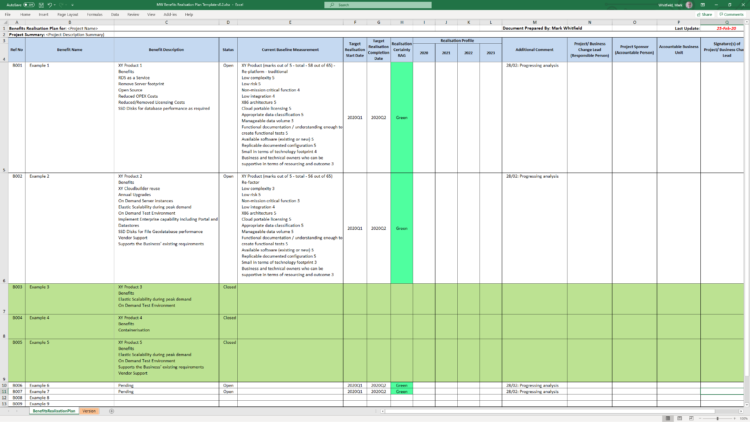
Programme, Project Benefits Realization Tracker MS Template for Recording & Tracking project benefits, baseline & status
MS Excel template for Programme & Project Benefits Realization tracking. Record benefits, baselines, targets & RAG status to monitor project outcomes.
$ 30$ 40 -
Prince2 & Agile Excel RAID log template, track project Risks, Assumptions, Issues, Dependencies (plus other key logs)
Prince2 & Agile Excel RAID log template to track Risks, Assumptions, Issues, Dependencies & more. Editable, comprehensive & ideal for project managers.
$ 30$ 40 -
Microsoft Excel Editable Weekly Status Report (internal external reporting) including Plan on a Page and RAIDs log etc.
Excel Weekly Status Report template with POaP, RAID log, burndown chart. For Agile or PRINCE2 projects. Editable for internal/external reporting.
$ 30$ 40