-
OpEx – Kaizen, Continuous Improvement
Facilitating Kaizen
The provided document, “OpEx-Facilitate CI-Kaizen.pdf” by Vishnu Rayapeddi, introduces Kaizen, a Japanese concept meaning gradual and orderly continuous improvement. It outlines a structured approach to fostering an organisational culture of sustained improvement by eliminating waste through various activities. The text highlights different types of Kaizen activities, including “Quick and Easy Kaizen” for daily small improvements and “Kaizen Events” (also known as “Kaizen Blitz”) for targeted, accelerated improvements. The Plan-Do-Check-Act (PDCA) cycle is presented as the core process for continuous improvement, emphasising the importance of standardising new processes to prevent regression. The document also details the planning, implementation, and follow-up phases for Kaizen events, suggesting a comprehensive framework for achieving operational excellence.$ 39$ 44 -
The Power and Magic of Lean by
The Power and Magic of Lean
The provided source offers an extensive overview of Lean principles and continuous improvement methodologies, largely attributed to the Toyota Production System (TPS). It introduces Norman Bodek, a prominent figure in propagating Japanese management techniques in the West, detailing his contributions and the various Lean tools he introduced, such as SMED, Poka-yoke, and Kaizen. The document meticulously outlines the nine wastes (Muda) that Lean aims to eliminate, including overproduction, waiting, and non-utilised talent, and explores concepts like Jidoka and Just-in-Time (JIT). Furthermore, it contrasts the characteristics of leaders and managers within a Lean context, emphasising the importance of respect for people and total employee involvement through practices like Quick and Easy Kaizen to foster a culture of perpetual small-scale improvements.$ 129$ 135The Power and Magic of Lean by
$ 129$ 135 -
OpEx – Lean JIT Kanban Systems
Kanban System Implementation
This source, titled “OpEx-KanbanSystems.pdf” by Vishnu Rayapeddi, provides a comprehensive overview of Kanban implementation within operational excellence frameworks. It explores the historical origins of Kanban from its roots in Toyota’s production system to its purpose in modern manufacturing. The document details the mechanics of Kanban, including visual systems, planning and scheduling integration, and various types such as withdrawal, production, and signal Kanbans. Furthermore, it highlights the significant benefits of adopting a Kanban system, such as inventory reduction and improved flow, and offers a seven-step guide to successful implementation, concluding with a practical case study for calculating Kanban numbers.$ 39$ 44OpEx – Lean JIT Kanban Systems
$ 39$ 44 -
OpEx – The Lean Office
Lean Thinking for Office and Admin Areas
This document, “OpEx_Lean_Office.pdf,” is a presentation by Vishnu Rayapeddi from Productivity Solutions (PSL) on Lean Thinking for Office & Admin Areas, copyrighted in 2011. It serves as a gateway to operational excellence, detailing various best-class practices such as Lean, Six Sigma, Total Quality Management (TQM), and the Theory of Constraints (TOC). The presentation’s core focuses on defining operational excellence and the elimination of waste through structured approaches like the Toyota Production System (TPS). It outlines a three-part methodology to “Lean your Business”: stabilise processes, standardise processes, and simplify processes, with practical tools and activities for each stage. The document ultimately aims to foster a continuous improvement culture within organisations to enhance productivity and reduce costs.$ 69$ 74OpEx – The Lean Office
$ 69$ 74 -
OpRx – Developing a Lean Culture
Develop a Lean Culture
The source, “OpEx – Develop a Lean Culture” by Vishnu Rayapeddi, argues that organisational culture is the most crucial element for business success, not just people. It highlights the high failure rate of Lean implementations, attributing these failures not to the Lean tools themselves, but to an unwillingness to change the underlying culture. The document defines culture, behaviour, and philosophy, and explains that a culture of continuous improvement, led by passionate and accountable leaders, is essential. It further asserts that employee engagement, fostered through meaningful work, development opportunities, and organisational alignment, is the primary driver for successful cultural transformation and achieving desired business outcomes, with Lean tools serving as mere enablers rather than the solution itself.$ 39$ 44OpRx – Developing a Lean Culture
$ 39$ 44 -
OpEx – Standardised Work
OpEx: Standard Work
The source, titled “OpEx – Standard Work” by Vishnu Rayapeddi, introduces Standard Work as a foundational element for achieving operational excellence in organisations. It explains that Standard Work, originating from the Toyota Production System, involves establishing agreed-upon, reliable procedures for tasks, leading to improved safety, quality, and efficiency while reducing waste and cost. The document outlines four steps to implementing Standard Work, including creating various charts, and stresses the importance of clear communication, user-friendly manuals, and regular revisions. Furthermore, it discusses the application of Standard Work in mistake-proofing and standardised training through the Training Within Industry (TWI) method, which encompasses Job Instruction (JI), Job Methods (JM), and Job Relations (JR). Finally, the source highlights the concept of Leader Standard Work, advocating for a process-dependent management system to ensure consistent leadership practices.$ 39$ 44OpEx – Standardised Work
$ 39$ 44 -
OpEx-5SVC-5S and Visual Controls
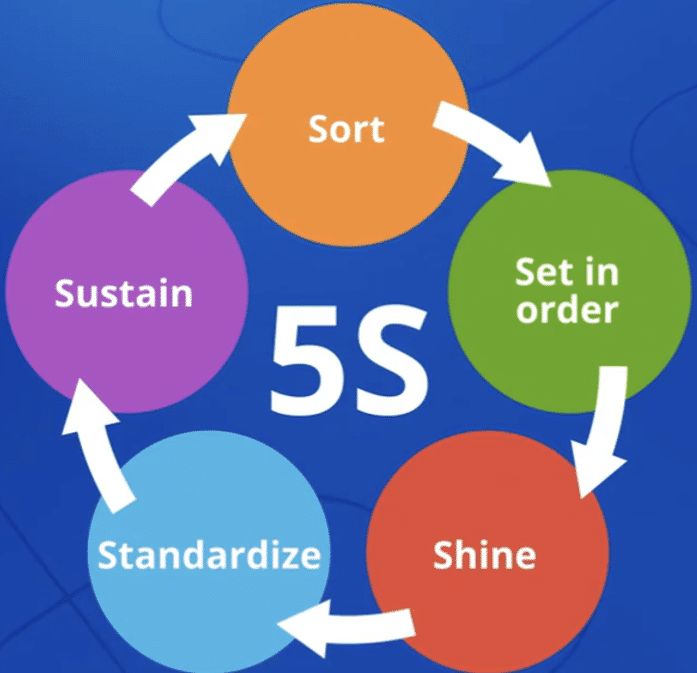
The source, titled “5S & Visual Controls for High Performance Workplace” by Vishnu Rayapeddi, outlines a comprehensive workshop focused on implementing the 5S methodology within an operational setting. This approach, originating from lean manufacturing principles, aims to create a safe, clean, and organised workplace to improve efficiency and quality. The document details each of the five “S” steps: Sort, Set-in-Order, Shine, Standardise, and Sustain, providing practical guidance, self-assessment tools, and examples for implementation. Ultimately, the objective is to achieve “World-Class Manufacturing” through disciplined workplace organisation and the effective use of visual controls and displays to communicate information and manage processes.
$ 54$ 64OpEx-5SVC-5S and Visual Controls
$ 54$ 64 -
OpEx-Quality, Problem Solving & Root Cause Analysis (RCA)
Problem Solving
The provided document, “OpEx – Quality & Problem Solving” by Vishnu Rayapeddi, offers a comprehensive guide to achieving operational excellence through effective quality management and problem-solving methodologies. It introduces the core concept of Zero Quality Control (ZQC), which aims for zero defects by preventing errors from becoming flaws, highlighting its importance for customer satisfaction and cost control. The text details various inspection approaches, contrasting traditional methods with ZQC’s source inspection, 100% inspection, short feedback loops, and mistake-proofing (Poka-Yoke). Furthermore, the document outlines a 5-step problem-solving method, incorporating tools like PDCA (Plan-Do-Check-Act), Fishbone Diagrams, Pareto Charts, Flow Charts, and Brainstorming techniques to identify root causes and implement continuous improvements.$ 29$ 34 -
OpEx – Lean MBA 2-day workshop PPT
Operational Excellence: A Lean-MBA Framework
The provided document, “OpEx-Lean-MBA 2day.pdf” by Vishnu Rayapeddi, outlines a Lean MBA framework designed to achieve Operational Excellence (BizEx). It introduces Business Excellence as outperforming competitors in key operational dimensions like quality, cost, and delivery, and continuously improving fundamental systems and customer satisfaction. The framework incorporates various best practices, including Total Quality Management (TQM), Six Sigma, Theory of Constraints (TOC), and the Toyota Production System (TPS), aiming to simplify processes, enhance quality, and increase competitiveness. The text details essential Lean tools such as Value Stream Mapping (VSM), 5S methodology, Total Productive Maintenance (TPM), Standardised Work, Kaizen, and Pull Systems, explaining their purpose and implementation for waste elimination and efficiency gains. Ultimately, the document serves as a comprehensive guide for organisations seeking to foster a culture of continuous improvement and achieve world-class operational performance.$ 109$ 119OpEx – Lean MBA 2-day workshop PPT
$ 109$ 119 -
OpEx – SSGB, Six Sigma Green Belt Training PPT
This text provides a comprehensive overview of Operational Excellence and Six Sigma methodologies, detailing their importance in enhancing business profitability, customer satisfaction, and market competitiveness. It introduces key quality management gurus like Deming, Juran, Crosby, Ishikawa, and Taguchi, outlining their foundational philosophies and contributions to quality improvement. The document then thoroughly explores the Six Sigma project lifecycle, from defining and measuring processes to analysing root causes, implementing solutions, and establishing robust control plans. Crucially, it integrates concepts of stakeholder management, financial analysis, and various data collection and analysis tools essential for successful Six Sigma implementatio
$ 249$ 269 -
OpEx – SCM Fundamentals – Demand Forecasting
This source, titled “OpEx- SCM Funda2 Forecasting.pdf” by Vishnu Rayapeddi, provides an extensive overview of demand forecasting within supply chain management. It begins by defining forecasting as educated guessing and a crucial process for business decisions across various time horizons, from short-range (under one year) to long-range (over three years). The document details different types of forecasts, including economic, technological, and demand, and outlines seven key steps in the forecasting process, from determining its use to validating results. Furthermore, the text distinguishes between qualitative forecasting methods (like the Delphi method and sales force composite) and quantitative methods (such as moving averages, exponential smoothing, and linear regression), explaining their applications and calculations, including metrics like Mean Absolute Deviation (MAD) and tracking signals for monitoring forecast accuracy.
$ 34$ 39 -
OpEx – SCM Fundamentals – MRP-Materials Requirement Planning
The source “OpEx-SCM Funda4 MRP.pdf” provides an overview of Materials Requirement Planning (MRP), a crucial component of supply chain management. It begins by distinguishing dependent versus independent demand and details the planning process that leads to Material Requirements Planning. The document explains Bills-of-Material (BOM), including different types like modular and phantom bills, and outlines the structure and benefits of an MRP system. Furthermore, it explores extensions of MRP, such as Closed Loop MRP, Capacity Planning, Manufacturing Resource Planning (MRP II), Enterprise Resource Planning (ERP), and Distribution Resource Planning (DRP), illustrating the evolution of these systems and their applications in both manufacturing and service sectors.
$ 24$ 29